I was standing in the produce section of my local grocery store last November when a cardboard box of persimmons tumbled off a display and rolled right toward my feet. I caught it—honestly, it was pure reflex—and the smell hit me all at once: that sweet, almost honeyed perfume of ripe Hachiya persimmons. And suddenly I was eight years old in my neighbor Mrs. Kowalski’s kitchen, watching her slice a persimmon open like it was a little orange sun. She always said the same thing: “You don’t eat these too early, kiddo. You wait until they’re soft as a secret.” I hadn’t thought about her in years. She moved away when I was twelve, and I never got her recipe for that dense, sticky, walnut-studded bread she’d bring over every Thanksgiving eve. But I remembered the way it smelled—like autumn had been baked into a loaf. So I stood there in the grocery aisle, holding that box of persimmons, and I decided I was going to figure it out myself.
The first batch was a disaster. I used Fuyu persimmons (the crunchy kind), and the bread turned out dry and sad. The second batch I didn’t let the Hachiyas ripen enough, and it had that weird, astringent mouth-pucker thing. My kitchen looked like a persimmon crime scene. But the third batch? That was the one. The loaf came out of the oven golden-brown and cracked across the top, with the walnuts toasted just right and the crumb so tender it practically whispered. I let it cool for exactly seventeen minutes—I counted—and then I sliced into it. The smell that came up was so close to Mrs. Kowalski’s kitchen that I actually had to sit down for a second. Maybe you’ve had that feeling, where a taste or a smell brings back a person so clearly you could almost hear their voice. That’s what this bread does to me. And now I’m sharing it with you, because honestly, a bread this good shouldn’t be a secret.
This isn’t just another quick bread recipe. It’s the one I’ve tested six times across two different ovens, the one I’ve brought to three dinner parties and watched disappear every single time. It’s the loaf that made my friend Jen text me at 10 p.m. asking for the recipe because her husband “wouldn’t stop talking about it.” It’s the bread that turns persimmons—those funny-looking fall fruits that everyone walks past—into the star of the show. And it’s surprisingly simple to pull off, which is the best kind of recipe, if you ask me.
Let me show you how to make it.
- Quick & Easy: Comes together in about 15 minutes of active prep time. The oven does the rest.
- Simple Ingredients: No weird specialty flours or hard-to-find extracts. Just real, whole-food ingredients you can find at any grocery store.
- Perfect for Hosting: This bread was born for dinner parties, potlucks, and holiday brunches. It looks impressive, slices beautifully, and travels well.
- Crowd-Pleaser: I’ve served it to persimmon-lovers and persimmon-skeptics alike. Everyone asks for seconds.
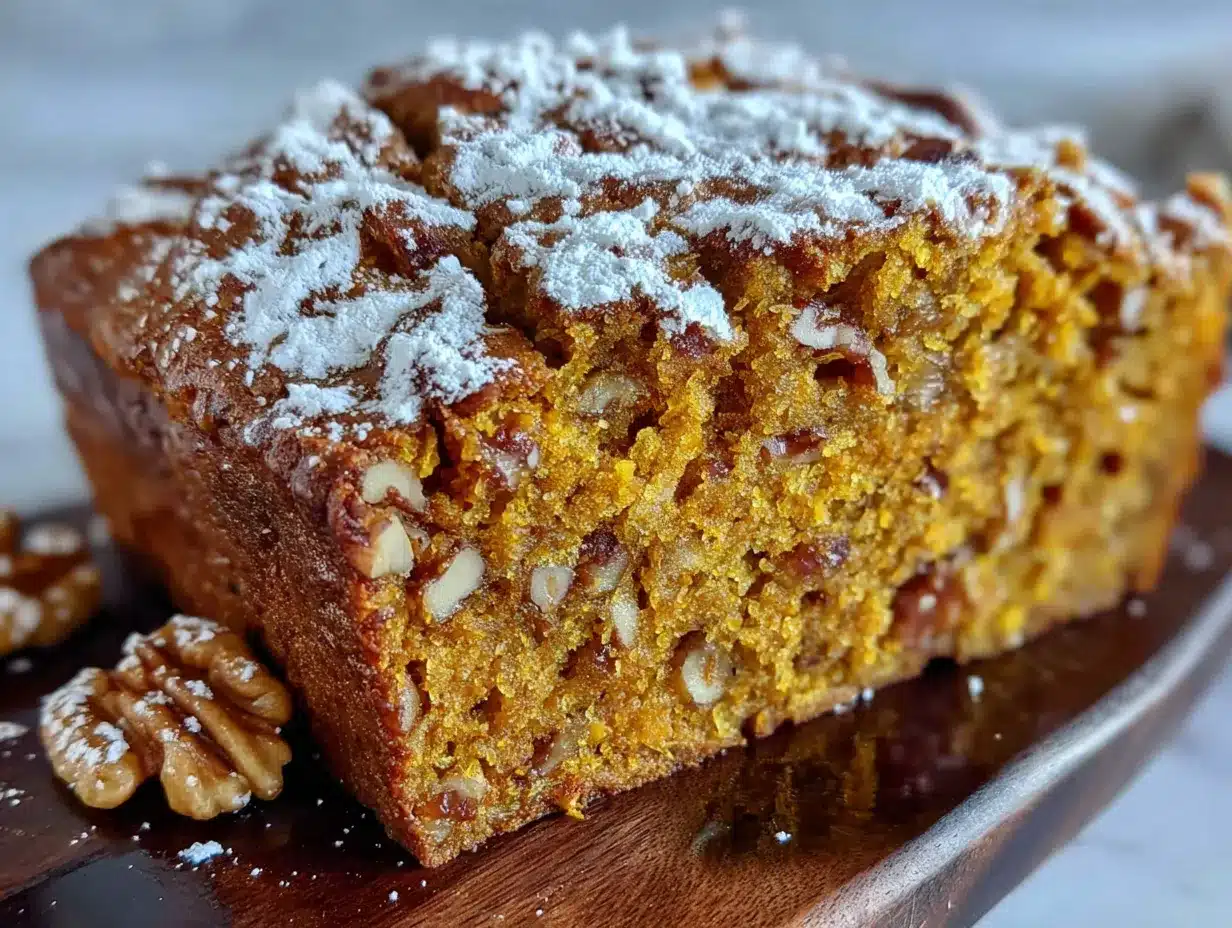
- Unbelievably Delicious: The texture is what gets people. It’s moist but not wet, tender but sturdy enough to hold a generous handful of toasted walnuts. The persimmon flavor is subtle and warm—like honey and cinnamon had a baby.
What makes this recipe different from every other persimmon bread out there? Two things. First, I use a combination of melted butter and Greek yogurt for moisture, which gives you that rich, pound-cake-like crumb without it being greasy. Second, I roast the persimmons before mashing them. I know—extra step. But trust me. Roasting concentrates the natural sugars and deepens the flavor in a way that raw persimmon puree just can’t match. It’s the difference between a good bread and a guest-favorite bread.
This recipe isn’t just good—it is the kind that makes you close your eyes after the first bite. It’s comfort food reimagined: slightly healthier, incredibly flavorful, but with the same soul-soothing satisfaction as your grandmother’s banana bread. Perfect for impressing guests without stress, or turning a simple fall afternoon into something memorable.
What Ingredients You Will Need
This recipe uses simple, wholesome ingredients to deliver bold flavor and satisfying texture without the fuss. Most of these are pantry staples, and the persimmons are the only specialty item—but they’re easy to find at any grocery store during fall and early winter.
For the Bread
- 3 to 4 very ripe Hachiya persimmons (about 1 ½ cups mashed) — Hachiyas are the acorn-shaped ones that get super soft when ripe. You want them practically collapsing in your hand. (Note: Do not use Fuyu persimmons here—they’re too firm and won’t give you the right texture.)
- 1 ¾ cups all-purpose flour (210 grams) — Spoon and level for accuracy. I’ve tested this with King Arthur Flour and Gold Medal; both work perfectly.
- 1 teaspoon baking soda
- ½ teaspoon baking powder
- ½ teaspoon salt
- 1 teaspoon ground cinnamon — I prefer Saigon cinnamon for its warmth, but any cinnamon works.
- ½ teaspoon ground ginger — Adds a subtle kick that pairs beautifully with persimmons.
- ¼ teaspoon ground nutmeg — Freshly grated if you have it, but pre-ground is fine.
- ½ cup unsalted butter (1 stick, 113 grams), melted and cooled slightly
- ¾ cup granulated sugar (150 grams)
- ¼ cup light brown sugar (50 grams), packed
- 2 large eggs, room temperature
- ¼ cup plain Greek yogurt (60 grams) — Full-fat or 2% both work. The yogurt adds moisture and a slight tang that balances the sweetness.
- 1 teaspoon vanilla extract
- 1 cup walnut halves or pieces (120 grams), toasted and roughly chopped — Toasting brings out their flavor and keeps them crunchy in the bread.
For the Glaze (Optional but Highly Recommended)
- ½ cup powdered sugar (60 grams)
- 1 to 2 tablespoons milk or cream
- ¼ teaspoon vanilla extract
- Pinch of cinnamon
Ingredient Tips: For the best texture, make sure your persimmons are so ripe they feel like a water balloon. If you can only find firm Hachiyas, let them sit on your counter at room temperature for 3 to 5 days until they soften. You can also speed this up by placing them in a paper bag with a banana. I buy my walnuts from the bulk bin section so I can get exactly the amount I need, and I always toast them in a dry skillet over medium heat for 3 to 4 minutes until they smell fragrant. Watch them closely—they burn fast.
Substitution Guidance: For a dairy-free version, use melted coconut oil instead of butter, and a dairy-free yogurt (coconut or soy-based). For a gluten-free option, substitute the all-purpose flour with a 1:1 gluten-free baking blend. I’ve tested this with Bob’s Red Mill 1:1 and it works beautifully, though the crumb is slightly more delicate. If you don’t have walnuts, pecans or toasted hazelnuts are excellent substitutes. And if you’re out of Greek yogurt, you can use sour cream or even buttermilk (reduce the milk in the glaze slightly to compensate).
Equipment Needed
You don’t need a fancy kitchen to make this bread. Here’s what you’ll need:
- 9×5-inch loaf pan — A standard metal or glass loaf pan works. If you use dark non-stick, reduce the oven temperature by 25°F to prevent over-browning.
- Parchment paper — For lining the pan. This makes lifting the bread out so much easier.
- Medium mixing bowl — For the dry ingredients.
- Large mixing bowl — For the wet ingredients.
- Whisk — For combining dry ingredients and smoothing the wet mixture.
- Rubber spatula — For folding everything together without overmixing.
- Box grater or food mill — For mashing the roasted persimmons. A potato masher or fork works too, but a food mill gives you the smoothest puree.
- Baking sheet — For roasting the persimmons.
- Small skillet — For toasting the walnuts (or you can use the oven while it preheats).
- Cooling rack — Essential for even cooling so the bottom doesn’t get soggy.
- Measuring cups and spoons — I prefer metal measuring cups for dry ingredients and glass for liquids.
- Kitchen scale — Optional but highly recommended for accuracy, especially with flour.
Budget-Friendly Alternatives: If you don’t have a food mill, a fine-mesh sieve and the back of a spoon work just as well for pureeing persimmons. No cooling rack? Invert a wire oven rack or use the grates from your toaster oven. And if you don’t have a 9×5-inch pan, you can use an 8×4-inch pan—just increase the baking time by 5 to 10 minutes and check for doneness with a toothpick.
Preparation Method
Let’s get baking. This recipe takes about 15 minutes of active prep and 55 to 65 minutes in the oven. I’ve broken it down into clear steps so you can follow along without stress.
Step 1: Roast the Persimmons
Preheat your oven to 375°F (190°C). While it’s heating, wash your persimmons and cut off the green calyx (the little leaf-like top). Slice them in half lengthwise and place them cut-side down on a parchment-lined baking sheet. Roast for 20 to 25 minutes, until they’re soft and starting to release their juices. The skins will look wrinkled and slightly caramelized. Let them cool for 10 minutes, then scoop the flesh out of the skins. It should slide right off. Mash the flesh with a fork or pass it through a food mill. You should have about 1 ½ cups of puree. Set aside to cool completely.
Personal tip: The first time I roasted persimmons, I forgot to line my baking sheet. The caramelized sugar stuck like glue, and I spent 20 minutes scrubbing. Learn from my mistake. Parchment paper is your friend here.
Step 2: Toast the Walnuts
While the persimmons roast, spread the walnut pieces on a separate baking sheet or in a dry skillet. Toast them in the oven (or on the stovetop) for 5 to 7 minutes, shaking the pan halfway through, until they’re fragrant and slightly darkened. Watch them carefully—they go from toasted to burnt very quickly. Let them cool completely, then roughly chop them into bite-sized pieces.
Step 3: Prepare the Loaf Pan
Reduce the oven temperature to 350°F (175°C). Grease your 9×5-inch loaf pan with butter or non-stick spray, then line it with a strip of parchment paper that hangs over the two long sides. This creates “handles” for lifting the bread out later. Set aside.
Step 4: Mix the Dry Ingredients
In a medium bowl, whisk together the flour, baking soda, baking powder, salt, cinnamon, ginger, and nutmeg. Whisk for about 15 seconds to aerate and distribute the leaveners evenly. Set aside.
Step 5: Mix the Wet Ingredients
In a large bowl, whisk together the melted butter, granulated sugar, and brown sugar until smooth and well combined. It should look like wet sand. Add the eggs one at a time, whisking well after each addition. Then whisk in the Greek yogurt, vanilla extract, and the cooled persimmon puree. The mixture should be smooth, glossy, and a beautiful deep orange-amber color.
Step 6: Combine Wet and Dry
Pour the dry ingredients into the wet ingredients. Use a rubber spatula to fold gently—just until you can’t see any more streaks of flour. A few small lumps are fine. Do not overmix. Overmixing develops gluten and will make your bread tough. Fold in the toasted walnuts until they’re evenly distributed.
Step 7: Bake
Pour the batter into the prepared loaf pan and smooth the top with your spatula. Bake at 350°F (175°C) for 55 to 65 minutes, or until a toothpick inserted into the center comes out clean or with a few moist crumbs. If the top is browning too quickly (after about 40 minutes), tent the pan loosely with aluminum foil.
Sensory cues: At the 30-minute mark, your kitchen will smell like autumn in a bakery. The top should be golden-brown and cracked by the time it’s done. If you press gently on the center, it should spring back.
Step 8: Cool and Glaze
Let the bread cool in the pan on a wire rack for 15 minutes. Then use the parchment handles to lift it out and transfer it to the rack to cool completely—about 1 hour. While it’s cooling, make the glaze by whisking together the powdered sugar, milk, vanilla, and cinnamon until smooth. Drizzle over the cooled bread. Let the glaze set for 10 minutes before slicing.
Preparation note: If you’re making this for a dinner party, you can bake the bread a day ahead. Store it tightly wrapped at room temperature, and glaze it just before serving. The flavors actually get better overnight.
Cooking Tips & Techniques
I’ve made this bread more times than I care to count, and I’ve learned a few things along the way. Let me save you some trouble.
The Persimmon Ripeness Rule: This is the most important tip in the entire post. Hachiya persimmons must be very ripe before you use them. If they’re even slightly firm, they’ll make your bread taste astringent and dry. I let mine sit on the counter for 4 to 5 days until they feel like a water balloon. When you cut into them, the flesh should be jelly-like and translucent. If it’s still orange and firm, they’re not ready.
The Roasting Shortcut: You can skip the roasting step and just mash raw persimmons. But I’ve tested both ways, and roasting gives you a deeper, more complex flavor. The caramelized sugars add a honey-like sweetness that raw persimmon puree can’t match. Plus, roasting concentrates the flavor, so your bread tastes more intensely of persimmon.
The Toasting Trick: I used to skip toasting walnuts. I was lazy, and I figured they’d toast in the oven anyway. They don’t. Untoasted walnuts taste slightly bitter and a little raw. Toasting them for 5 minutes transforms them into nutty, crunchy perfection. Do it. You won’t regret it.
The Mixing Mistake: I ruined my first successful batch by overmixing. I was so excited that the batter looked beautiful that I kept folding. The bread came out dense and tough. Quick breads are forgiving, but they’re not that forgiving. Mix until just combined. Lumps are okay. Trust the process.
The Doneness Test: Toothpick tests can lie. Sometimes the toothpick comes out clean but the center is still underdone. I use two tests: the toothpick test and the gentle press test. Press the center of the bread with your fingertip. If it springs back, it’s done. If it leaves an indent, give it 5 more minutes.
Timing Strategy for Hosting: If you’re making this for a dinner party, here’s my game plan. Roast the persimmons and toast the walnuts the night before. Store them separately in the fridge. The next day, the actual prep takes 15 minutes, and the bread bakes while you’re setting the table. Your guests will walk into a kitchen that smells incredible, and you’ll look like a hero.
Variations & Adaptations
One of the best things about this bread is how adaptable it is. Here are a few variations I’ve tried and loved.
Vegan Version: Replace the butter with melted coconut oil or vegan butter. Use flax eggs (1 tablespoon ground flaxseed mixed with 2.5 tablespoons water per egg) instead of regular eggs. Use a plant-based Greek yogurt (I like Kite Hill or Silk’s plain unsweetened). The texture will be slightly denser but still delicious.
Gluten-Free Version: Substitute the all-purpose flour with a 1:1 gluten-free baking blend. I’ve tested this with Bob’s Red Mill 1:1 and Cup4Cup, and both work well. Add 1 teaspoon of xanthan gum if your blend doesn’t include it. The crumb will be a bit more delicate, so let the bread cool completely before slicing.
Spiced Chai Variation: Add 1 teaspoon of chai spice blend (or a mix of cardamom, cloves, and black pepper) along with the cinnamon. It gives the bread a warm, aromatic twist that’s perfect for holiday gatherings.
Chocolate Chip Version: Fold in ½ cup of dark chocolate chips along with the walnuts. The bitterness of the chocolate pairs beautifully with the sweet persimmon. My friend Sarah calls this “the breakfast dessert” and I can’t argue with her.
Orange-Glazed Version: Replace the vanilla in the glaze with 1 tablespoon of fresh orange juice and ½ teaspoon of orange zest. The citrus brightens the persimmon flavor and adds a lovely tang.
Personal Variation: My favorite way to make this bread is with a streusel topping. Mix ¼ cup flour, ¼ cup brown sugar, 2 tablespoons cold butter, and ½ teaspoon cinnamon until crumbly. Sprinkle it over the batter before baking. It adds a crunchy, buttery layer that makes the bread feel even more special.
Serving & Storage Suggestions
This bread is incredibly versatile when it comes to serving. Here’s how I like to do it.
Serving Temperature: Serve at room temperature or slightly warm. If you’re reheating slices, pop them in a 300°F (150°C) oven for 5 to 7 minutes, or microwave for 15 to 20 seconds. The glaze will soften slightly, but that’s part of the charm.
Presentation Tips: For a dinner party, slice the bread into thick, even pieces and arrange them on a wooden board. Dust with a little powdered sugar and add a few fresh persimmon slices or pomegranate arils for color. It looks stunning with minimal effort.
What to Serve Alongside: This bread pairs beautifully with a cup of chai, spiced apple cider, or a bold black coffee. For brunch, serve it alongside a frittata or a simple arugula salad with lemon vinaigrette. The sweetness of the bread balances savory dishes perfectly.
Storage Instructions: Store the bread tightly wrapped in plastic wrap or in an airtight container at room temperature for up to 4 days. If you’ve glazed it, let the glaze set completely before wrapping, or the glaze will get sticky.
Freezer Instructions: This bread freezes beautifully. Wrap the cooled, unglazed loaf tightly in plastic wrap, then in a layer of aluminum foil. Freeze for up to 3 months. To thaw, leave it on the counter overnight. Glaze after thawing for best results. You can also freeze individual slices for quick breakfasts or snacks.
Flavor Development: Here’s a little secret: this bread tastes even better on day two. The persimmon flavor deepens and the spices meld together overnight. If you can resist eating it immediately, wrap it up and let it sit for 24 hours. You’ll be rewarded with an even more delicious loaf.
Nutritional Information & Benefits
This bread is a treat, but it also has some surprising nutritional benefits. Here’s the breakdown per slice (assuming 10 slices per loaf, with glaze).
| Nutrient | Amount per Slice |
|---|---|
| Calories | 285 |
| Total Fat | 13g |
| Saturated Fat | 5g |
| Cholesterol | 45mg |
| Sodium | 210mg |
| Total Carbohydrates | 38g |
| Dietary Fiber | 2g |
| Sugars | 22g |
| Protein | 4g |
Health Benefits of Key Ingredients: Persimmons are packed with vitamin A (important for eye health), vitamin C, and antioxidants like beta-carotene. They also contain fiber, which supports digestive health. Walnuts are an excellent source of omega-3 fatty acids, which are great for brain health and reducing inflammation. Cinnamon and ginger both have anti-inflammatory properties.
Dietary Considerations: This recipe contains gluten, dairy, eggs, and tree nuts (walnuts). For allergen-friendly versions, see the Variations section above. To make it lower in sugar, you can reduce the granulated sugar to ½ cup and the brown sugar to 2 tablespoons. The bread will be less sweet but still delicious, especially if you skip the glaze.
Personal Wellness Perspective: I don’t believe in labeling foods as “good” or “bad.” This bread is a celebration of fall flavors, made with real ingredients. Enjoy a slice as part of a balanced diet. It’s the kind of treat that nourishes more than just your body—it nourishes your memories, too.
Conclusion
This Guest-Favorite Persimmon Walnut Bread is more than just a recipe. It’s a way to capture the warmth of autumn, the comfort of a shared meal, and the joy of bringing something beautiful to the table. Whether you’re serving it at a holiday brunch, a casual dinner party, or just for yourself on a quiet Sunday morning, it delivers every single time.
I’ve tested this recipe until it was just right—not too sweet, perfectly moist, with that satisfying crunch of toasted walnuts in every bite. And I’ve shared all my tips and tricks so you can skip the trial-and-error and go straight to the good part: pulling a golden-brown loaf out of your oven and watching it disappear.
I’d love to hear how yours turns out. Did you add chocolate chips? Try the chai spice version? Serve it with something unexpected? Drop a comment below and let me know. And if you share a photo on Pinterest or Instagram, tag me—I want to see your beautiful bread.
Go ahead. Grab those persimmons while they’re in season. Your guests will thank you.
Frequently Asked Questions
Can I use Fuyu persimmons instead of Hachiya?
I don’t recommend it. Fuyu persimmons are the squat, tomato-shaped variety that stay firm even when ripe. They have a different texture and sugar content, and they won’t give you the same moist, tender crumb. Stick with Hachiya persimmons for this recipe. If you can only find Fuyus, you can try roasting them first to soften them, but the results won’t be the same.
How do I know when persimmons are ripe enough?
Ripe Hachiya persimmons should feel like a water balloon—very soft and almost jelly-like inside. The skin will be deep orange-red and may have a few brown spots. If they’re still firm, leave them on your counter at room temperature for 3 to 5 days. You can speed up the process by placing them in a paper bag with a banana or apple.
Can I make this bread without a mixer?
Absolutely. This recipe is designed to be made by hand with a whisk and a rubber spatula. No electric mixer needed. In fact, mixing by hand reduces the risk of overmixing, which can make the bread tough. It’s a great recipe for beginner bakers or anyone who doesn’t want to drag out heavy equipment.
Why did my bread sink in the middle?
A sunken middle usually means the bread was underbaked. Quick breads need a full 55 to 65 minutes in the oven, and the center is the last part to set. Make sure your oven is at the correct temperature (an oven thermometer helps), and don’t open the oven door during the first 40 minutes of baking. If the top is browning too quickly, tent it with foil.
Can I double this recipe?
Yes! This recipe doubles beautifully. Use two 9×5-inch loaf pans and bake them on the same oven rack, spaced at least 2 inches apart. The baking time may increase by 5 to 10 minutes, so start checking for doneness at the 55-minute mark. This is perfect for holiday gift-giving or feeding a crowd.
Pin This Recipe!
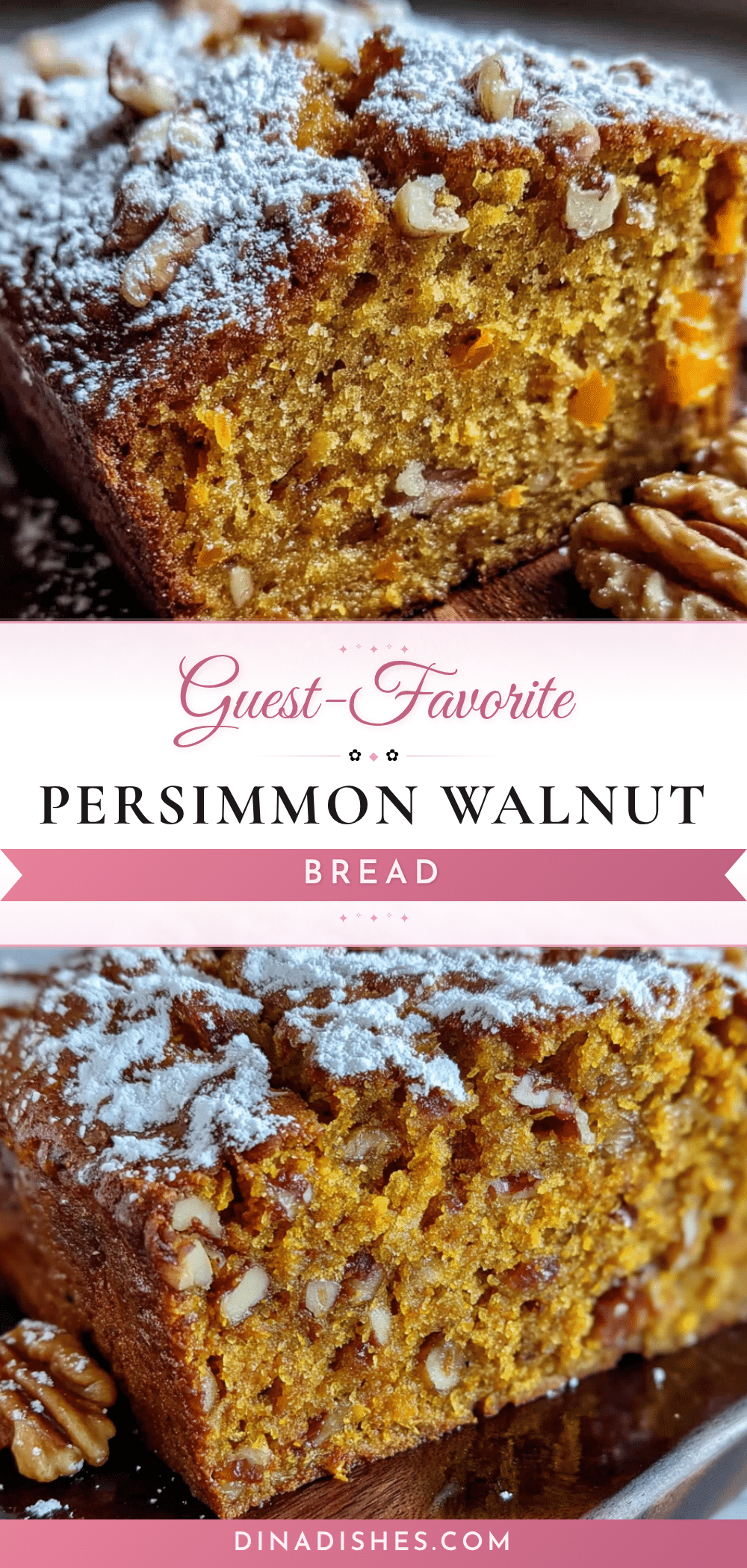
The Best Persimmon Walnut Bread Recipe (Guest Favorite)

This persimmon walnut bread is moist, tender, and packed with roasted persimmon flavor and crunchy toasted walnuts. It’s a guest-favorite recipe that’s surprisingly simple to make and perfect for fall gatherings.
- Prep Time: 15 minutes
- Cook Time: 55 to 65 minutes
- Total Time: 1 hour 10 minutes to 1 hour 20 minutes
- Yield: 10 servings 1x
- Category: Dessert
- Cuisine: American
Ingredients
- 3 to 4 very ripe Hachiya persimmons (about 1 ½ cups mashed)
- 1 ¾ cups all-purpose flour (210 grams)
- 1 teaspoon baking soda
- ½ teaspoon baking powder
- ½ teaspoon salt
- 1 teaspoon ground cinnamon
- ½ teaspoon ground ginger
- ¼ teaspoon ground nutmeg
- ½ cup unsalted butter (1 stick, 113 grams), melted and cooled slightly
- ¾ cup granulated sugar (150 grams)
- ¼ cup light brown sugar (50 grams), packed
- 2 large eggs, room temperature
- ¼ cup plain Greek yogurt (60 grams)
- 1 teaspoon vanilla extract
- 1 cup walnut halves or pieces (120 grams), toasted and roughly chopped
- ½ cup powdered sugar (60 grams)
- 1 to 2 tablespoons milk or cream
- ¼ teaspoon vanilla extract
- Pinch of cinnamon
Instructions
- Preheat oven to 375°F (190°C). Wash persimmons, cut off green calyx, slice in half lengthwise, and place cut-side down on a parchment-lined baking sheet. Roast for 20 to 25 minutes until soft and juices release. Let cool 10 minutes, then scoop flesh from skins and mash to make about 1 ½ cups puree. Set aside to cool completely.
- While persimmons roast, spread walnut pieces on a baking sheet or in a dry skillet. Toast in oven or on stovetop for 5 to 7 minutes, shaking halfway, until fragrant. Let cool completely, then roughly chop.
- Reduce oven temperature to 350°F (175°C). Grease a 9×5-inch loaf pan with butter or non-stick spray, then line with parchment paper overhanging the long sides.
- In a medium bowl, whisk together flour, baking soda, baking powder, salt, cinnamon, ginger, and nutmeg for about 15 seconds.
- In a large bowl, whisk together melted butter, granulated sugar, and brown sugar until smooth. Add eggs one at a time, whisking well after each. Whisk in Greek yogurt, vanilla extract, and cooled persimmon puree until smooth and glossy.
- Pour dry ingredients into wet ingredients. Fold gently with a rubber spatula until just combined—a few small lumps are fine. Do not overmix. Fold in toasted walnuts until evenly distributed.
- Pour batter into prepared loaf pan and smooth the top. Bake at 350°F (175°C) for 55 to 65 minutes, until a toothpick inserted in center comes out clean or with a few moist crumbs. If top browns too quickly, tent with foil after about 40 minutes.
- Let bread cool in pan on a wire rack for 15 minutes. Use parchment handles to lift out and transfer to rack to cool completely, about 1 hour.
- While cooling, make glaze: whisk together powdered sugar, 1 to 2 tablespoons milk or cream, ¼ teaspoon vanilla extract, and a pinch of cinnamon until smooth. Drizzle over cooled bread. Let glaze set for 10 minutes before slicing.
Notes
For best results, use very ripe Hachiya persimmons that feel like a water balloon. Roasting the persimmons deepens the flavor. Do not overmix the batter. The bread tastes even better on day two. For dairy-free, use melted coconut oil and dairy-free yogurt. For gluten-free, use a 1:1 gluten-free baking blend.
Nutrition
- Serving Size: 1 slice
- Calories: 285
- Sugar: 22
- Sodium: 210
- Fat: 13
- Saturated Fat: 5
- Carbohydrates: 38
- Fiber: 2
- Protein: 4
Keywords: persimmon bread, walnut bread, fall baking, quick bread, persimmon recipe, holiday bread, brunch recipe