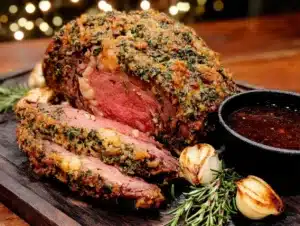
There used to be a tiny, wood-paneled steakhouse on the corner of 7th and Maple in my hometown—The Iron Skillet—that made a prime rib that was nothing short of legendary. When they closed their doors after thirty years, I honestly felt a little lost. That first bite of their herb-crusted roast, with the rich red wine jus pooling on the plate, was the kind of experience you just couldn’t replicate. After seven tries—some too salty, one where I forgot the thyme entirely, and a particularly sad attempt that came out medium-well when I wanted medium-rare—I finally got it. This is that recipe.
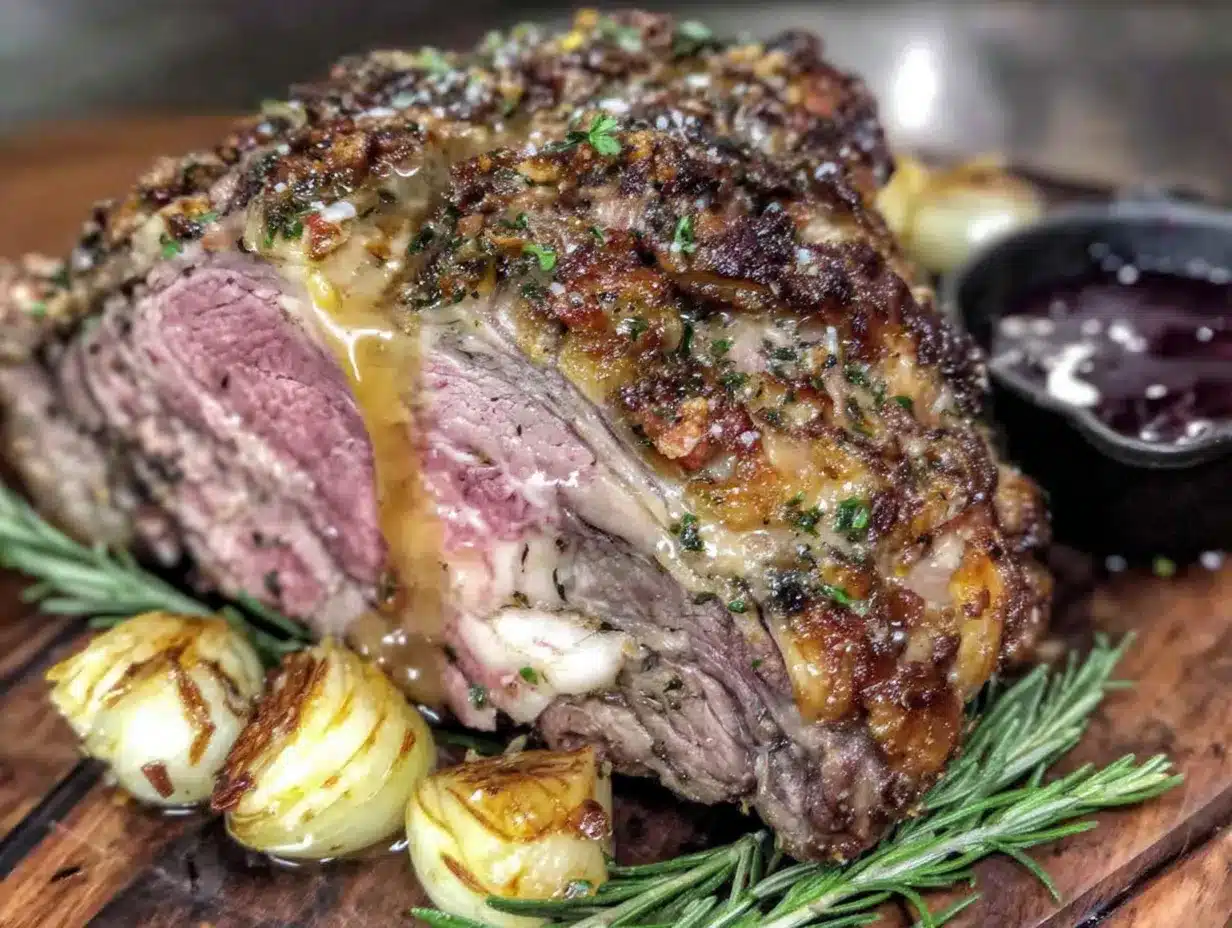
The secret, let me tell you, isn’t just in the cut of meat. It’s in the way the fresh herbs cling to the fat cap, creating a crust that shatters when you slice into it. I remember standing in my kitchen last Christmas Eve, the rain hammering against the window, and thinking, “If I can just get the crust right, everything else will follow.” And it did. The smell alone—rosemary, garlic, a hint of black pepper—filled the whole house and had my family hovering around the oven door like we were kids again.
Maybe you’ve been there, hunting for that one perfect centerpiece dish that makes everyone stop talking and just *eat*. This herb-crusted prime rib roast with red wine jus is that dish. It’s the kind of meal that turns a regular Tuesday into a celebration, and honestly, it’s easier than you think. Let me show you how to bring that steakhouse magic home.
Why You’ll Love This Recipe
This isn’t just another prime rib recipe. I’ve tested this method on a dozen different roasts, for everything from small family dinners to a holiday gathering of sixteen people. It works every single time. Here’s why this one is different.
- Foolproof Crust: The herb mixture isn’t just slapped on. I use a technique of patting the roast dry, scoring the fat cap, and letting the herbs form a thick, flavorful bark that locks in every drop of juice.
- Stress-Free Hosting: You can prep the herb crust and even sear the roast hours before your guests arrive. When it’s time to eat, just pop it in the oven. No last-minute panic, I promise.
- Restaurant-Quality Jus: The red wine jus isn’t an afterthought. It’s built right into the roasting pan, using the browned bits from the meat. It’s rich, silky, and makes the whole dish feel like a splurge.
- Perfect for a Crowd: This roast scales beautifully. Whether you’re feeding six or twelve, the method stays the same. It’s the ultimate showstopper for a dinner party, holiday table, or any gathering where you want to impress.
- Unbelievably Tender: The slow-roast method at a low temperature, followed by a high-heat sear, gives you that perfect edge-to-edge pink doneness. No gray bands, no dry spots—just juicy, tender meat from the first slice to the last.
I’ve had people tell me this is the best prime rib they’ve ever eaten. And I’m not saying that to brag—I’m saying it because I’ve put in the work to make sure this recipe is bulletproof. It’s the kind of dish that makes you close your eyes after that first bite and forget you’re the one who cooked it.
What Ingredients You Will Need
This recipe uses a handful of high-quality ingredients to build layers of flavor. Don’t skimp on the fresh herbs—they’re the backbone of that gorgeous crust.
For the Prime Rib Roast
- 1 (6-8 pound) bone-in prime rib roast (also called standing rib roast; ask your butcher for the first cut, from the large end, for the most marbling)
- 2 tablespoons kosher salt (use Diamond Crystal if you can; it’s less salty by volume and gives better control)
- 1 tablespoon freshly cracked black pepper (don’t use pre-ground here—the texture matters)
- ¼ cup fresh rosemary, finely chopped (about 4-5 sprigs)
- ¼ cup fresh thyme leaves (strip them from the stems—it takes a minute but it’s worth it)
- 2 tablespoons fresh oregano, chopped (optional but adds a lovely earthy note)
- 6 cloves garlic, minced (use a microplane for a paste-like consistency)
- 3 tablespoons olive oil (extra virgin is fine, but a good quality one makes a difference)
For the Red Wine Jus
- 2 cups dry red wine (I recommend a Cabernet Sauvignon or Merlot—something you’d actually drink)
- 2 cups beef broth (low-sodium is best so you can control the salt; I like Better Than Bouillon roasted beef base)
- 1 small shallot, finely diced (about 2 tablespoons)
- 2 tablespoons unsalted butter (cold, cut into small cubes—this is the secret to a silky finish)
- 1 tablespoon all-purpose flour (optional, for a thicker jus; I usually skip it for a cleaner flavor)
- Fresh thyme sprigs and rosemary sprig (for infusing the jus)
- Salt and pepper to taste
One thing I’ve learned the hard way: let your meat come to room temperature before roasting. I know it sounds like an extra step, but a cold roast will cook unevenly and your beautiful crust won’t form the same way. Take it out of the fridge at least 2 hours before you plan to cook it. Trust me on this one.
Equipment Needed
You don’t need a professional kitchen to pull this off, but having the right tools makes everything smoother. Here’s what you’ll need.
- Large roasting pan with a rack: A V-rack is ideal because it lifts the roast above the pan juices, allowing hot air to circulate for even cooking. If you don’t have a rack, you can use a bed of thick-cut carrots and onions—they’ll flavor the jus, too.
- Instant-read thermometer: This is non-negotiable. Prime rib is too expensive to guess. I use a Thermapen, but any reliable digital thermometer will do.
- Chef’s knife and cutting board: A sharp knife makes slicing the roast a dream. Dull knives will tear the meat.
- Small saucepan: For finishing the red wine jus on the stovetop.
- Kitchen twine: To tie the roast between the bones. This helps it hold its shape and cook evenly.
- Aluminum foil: For tenting the roast while it rests. Resting is not optional—it’s where the magic happens.
I’ve made this roast in a cheap, thin roasting pan and in a heavy-duty one. The heavy pan distributes heat better and gives a more even sear. If you’re investing in one piece of equipment for holiday cooking, make it a good roasting pan.
Preparation Method
Let’s get cooking. This method is broken into clear steps so you can follow along without stress. I’ve included time estimates and sensory cues to help you know exactly what to look for.
Step 1: Prep the Roast (30 minutes before cooking)
Remove the prime rib from the fridge and let it sit on the counter for 2 hours to come to room temperature. Pat it completely dry with paper towels—moisture is the enemy of a good crust. Using a sharp knife, score the fat cap in a crosshatch pattern, cutting about ¼ inch deep. This helps the herbs penetrate and creates those crispy edges everyone fights over.
Step 2: Make the Herb Crust (10 minutes)
In a small bowl, combine the chopped rosemary, thyme, oregano, minced garlic, olive oil, kosher salt, and black pepper. Mix it into a paste. It should smell incredibly aromatic—if it doesn’t, your herbs might be old. Rub this mixture all over the roast, pressing it firmly into the scored fat cap and all sides. Don’t forget the ends. Place the roast bone-side down on the rack in your roasting pan. Tie it with kitchen twine between each bone to keep it compact.
Step 3: The Slow Roast (about 2.5 to 3 hours)
Preheat your oven to 275°F (135°C). Yes, that low. This is the key to even doneness. Roast the prime rib until the internal temperature reaches 115°F (46°C) for rare, or 125°F (52°C) for medium-rare. Start checking the temperature at the 2-hour mark. Insert the thermometer into the center of the roast, away from the bone. The meat will feel springy but not firm when you press it.
Step 4: The High-Heat Sear (15 minutes)
Once the roast hits your target temperature, remove it from the oven. Increase the oven temperature to 500°F (260°C). While it’s heating, tent the roast loosely with foil. After the oven reaches 500°F, remove the foil and return the roast to the oven. Roast for 10-15 minutes, until the crust is deep golden brown and crackling. Watch it closely—it can go from perfect to burnt in seconds.
Step 5: Rest the Roast (20-30 minutes)
Remove the roast from the oven and transfer it to a cutting board. Tent it loosely with foil and let it rest for at least 20 minutes. Do not skip this step. The internal temperature will rise another 5-10°F during resting (this is called carryover cooking). The rest allows the juices to redistribute so every slice is tender.
Step 6: Make the Red Wine Jus (15 minutes)
While the roast rests, place the roasting pan on the stovetop over medium heat. Add the diced shallot and cook for 1-2 minutes, scraping up the browned bits from the bottom of the pan. Pour in the red wine and bring to a simmer. Let it reduce by half, about 5 minutes. Add the beef broth and the herb sprigs. Simmer for another 5 minutes. Strain the jus through a fine-mesh sieve into a small saucepan. Whisk in the cold butter, one cube at a time, until the jus is glossy and slightly thickened. Season with salt and pepper to taste.
Step 7: Slice and Serve
Remove the twine and slice between the bones to separate the roast into individual ribs. Then slice the meat against the grain into ½-inch thick pieces. Arrange on a platter, spoon some of the red wine jus over the top, and serve the remaining jus on the side.
Cooking Tips & Techniques
I’ve made every mistake you can imagine with prime rib. Here’s what I’ve learned so you don’t have to repeat my failures.
Don’t skip the rest. I once carved a roast immediately because I was hungry and impatient. The juices flooded the cutting board, and the meat was dry and sad. Letting it rest for 20-30 minutes is the single most important step for tenderness.
Use a thermometer, not a timer. Every oven runs differently. A 6-pound roast might take 2.5 hours in my oven and 3 hours in yours. Relying on time alone is a gamble. The thermometer doesn’t lie.
Score the fat cap deeply. I used to just rub herbs on top, and the flavor never really penetrated. Scoring the fat creates little pockets for the herb paste to sink into. The result is a crust that’s flavorful all the way through, not just on the surface.
Let the wine breathe in the jus. If you add the wine and immediately add the broth, the alcohol won’t cook off properly and the jus will taste harsh. Let the wine simmer and reduce until it’s syrupy and the sharp smell is gone. That’s when you know it’s ready for the broth.
Plan your timing backward. If guests are arriving at 6 PM, work backward from there. Rest at 5:30, sear at 5:15, slow roast starting at 2:30 or 3:00. Write it down if you have to. I keep a sticky note on my fridge every holiday season.
Variations & Adaptations
This recipe is a fantastic base, but don’t be afraid to make it your own. Here are a few variations I’ve tried and loved.
Garlic & Herb Butter Crust
Swap the olive oil for 4 tablespoons of softened unsalted butter. Mix the herbs and garlic into the butter, then spread it all over the roast. The butter adds richness and helps the crust brown even more deeply. I do this for Christmas dinner every year.
Smoked Prime Rib
If you have a smoker, this is a game-changer. Set your smoker to 225°F (107°C) with hickory or oak wood. Smoke the roast until it reaches 115°F internal, then finish with a high-heat sear on a grill or in the oven. The smoky flavor pairs beautifully with the herbs and red wine jus.
Peppercorn Crust Variation
For a bolder, spicier crust, reduce the rosemary to 2 tablespoons and add 2 tablespoons of coarsely crushed black peppercorns and 1 tablespoon of crushed pink peppercorns. This gives a gorgeous, fragrant crust that’s perfect for a dinner party with a kick.
Dairy-Free Jus
The butter at the end gives the jus its silky finish, but you can skip it or use a dairy-free butter alternative. The jus will still be flavorful, just slightly less glossy. I’ve done this for guests with dairy allergies and it’s still delicious.
Serving & Storage Suggestions
This prime rib is the centerpiece of the meal, so let it shine. Here’s how to serve and store it like a pro.
Serving: Slice the roast and arrange it on a large, warm platter. Spoon a little of the red wine jus over the top and serve the rest in a gravy boat. I like to garnish with fresh rosemary sprigs and a few whole roasted garlic cloves for a beautiful presentation. Serve alongside creamy mashed potatoes, roasted asparagus, or a simple arugula salad with lemon vinaigrette to cut through the richness.
Storage: Leftover prime rib is a gift. Store sliced meat in an airtight container in the refrigerator for up to 4 days. The jus can be stored separately in a jar for up to 5 days. The flavors actually deepen overnight, making leftovers almost better than the first serving.
Reheating: The best way to reheat prime rib without drying it out is in a low oven. Place slices in a baking dish, add a splash of beef broth or the reserved jus, cover with foil, and warm at 300°F (150°C) for 10-15 minutes. You can also reheat slices gently in a skillet with a little butter over medium-low heat. Avoid the microwave—it will turn your beautiful roast into shoe leather.
Freezing: Prime rib freezes well for up to 3 months. Wrap slices tightly in plastic wrap, then foil, and place in a freezer bag. Thaw overnight in the refrigerator before reheating using the low oven method above.
Nutritional Information & Benefits
Prime rib is an indulgence, but it also has some nutritional merits worth noting. Here’s a rough estimate per serving (based on a 6-ounce portion with 2 tablespoons of jus).
Estimated Nutrition per Serving:
- Calories: 520
- Protein: 45g
- Fat: 38g
- Saturated Fat: 15g
- Carbohydrates: 3g
- Sodium: 480mg
Health Benefits: Beef is an excellent source of high-quality protein, which is essential for muscle repair and satiety. It’s also rich in iron, zinc, and B vitamins, particularly B12, which supports energy metabolism and nerve function. The fresh herbs in the crust—rosemary, thyme, oregano—are packed with antioxidants and anti-inflammatory compounds. Red wine, in moderation, contains resveratrol, which has been linked to heart health.
Dietary Considerations: This recipe is naturally gluten-free (skip the flour in the jus if needed) and low-carb. It is not suitable for vegetarian or vegan diets. For those watching sodium, use low-sodium broth and go easy on the added salt in the herb crust.
I’m not a nutritionist, but I believe in balance. A meal like this is about celebration and connection. Pair it with a big green salad and roasted vegetables, and you’ve got a plate that’s both satisfying and nourishing.
Conclusion
This herb-crusted prime rib roast with red wine jus isn’t just a recipe—it’s a memory waiting to happen. It’s the dish that brings people to the table, makes them lean in close, and turns an ordinary evening into something special. I’ve made it for quiet Thanksgivings and boisterous New Year’s Eve parties, and every time, it delivers. The crackling herb crust, the tender, pink meat, the rich, silky jus—it’s a combination that never gets old.
I want you to take this recipe and make it your own. Adjust the herbs, try the smoked version, or double the garlic if you’re bold. The best part of cooking is the freedom to play. And if you nail it on your first try? Even better. If you don’t? That’s okay, too. I didn’t get it right until attempt number seven.
So go ahead—invite your people over, pour a glass of that red wine, and get roasting. I promise you, the looks on their faces when you bring that roast to the table will be worth every minute. If you make this, I’d love to hear about it. Drop a comment below, share your photos, and let me know how it turned out. Happy cooking!
Frequently Asked Questions
Can I use a boneless prime rib roast for this recipe?
Yes, absolutely. Boneless roasts cook slightly faster because there’s no bone to conduct heat. Use the same herb crust and method, but start checking the temperature about 30 minutes earlier than you would for a bone-in roast. The jus will still be delicious—just make sure you have enough browned bits in the pan.
How do I know when the prime rib is done without a thermometer?
Honestly, I don’t recommend it. Prime rib is too expensive to guess. But if you’re in a pinch, you can use the “hand test.” Touch the meat: if it feels like the fleshy part of your palm below your thumb when your hand is relaxed, it’s rare. If it feels like that same spot when you touch your thumb to your middle finger, it’s medium-rare. It’s not perfect, but it’s a decent backup.
Can I prepare the herb crust ahead of time?
Yes! You can mix the herb paste up to 24 hours in advance and store it in the refrigerator. Let it come to room temperature before rubbing it onto the roast. This actually helps the flavors meld together even more. Just don’t rub the roast too early—the salt will draw out moisture and make the crust soggy. Apply the herb paste about 1-2 hours before roasting.
What should I serve with prime rib for a dinner party?
I love keeping the sides classic and simple. Creamy mashed potatoes or roasted baby potatoes are a must to soak up the red wine jus. Roasted asparagus with lemon, a crisp green salad with a tangy vinaigrette, and Yorkshire puddings if you’re feeling traditional. For dessert, a light option like a berry pavlova or chocolate mousse rounds out the meal beautifully.
How do I prevent the red wine jus from being too bitter?
Bitterness usually comes from reducing the wine too much or using a wine that’s overly tannic. Stick with a wine you enjoy drinking—if it’s smooth and balanced in the glass, it will be smooth in the jus. Also, don’t reduce the wine past a syrupy consistency. And that cold butter at the end? It’s not just for shine—it mellows out any sharp edges in the flavor.
Pin This Recipe!
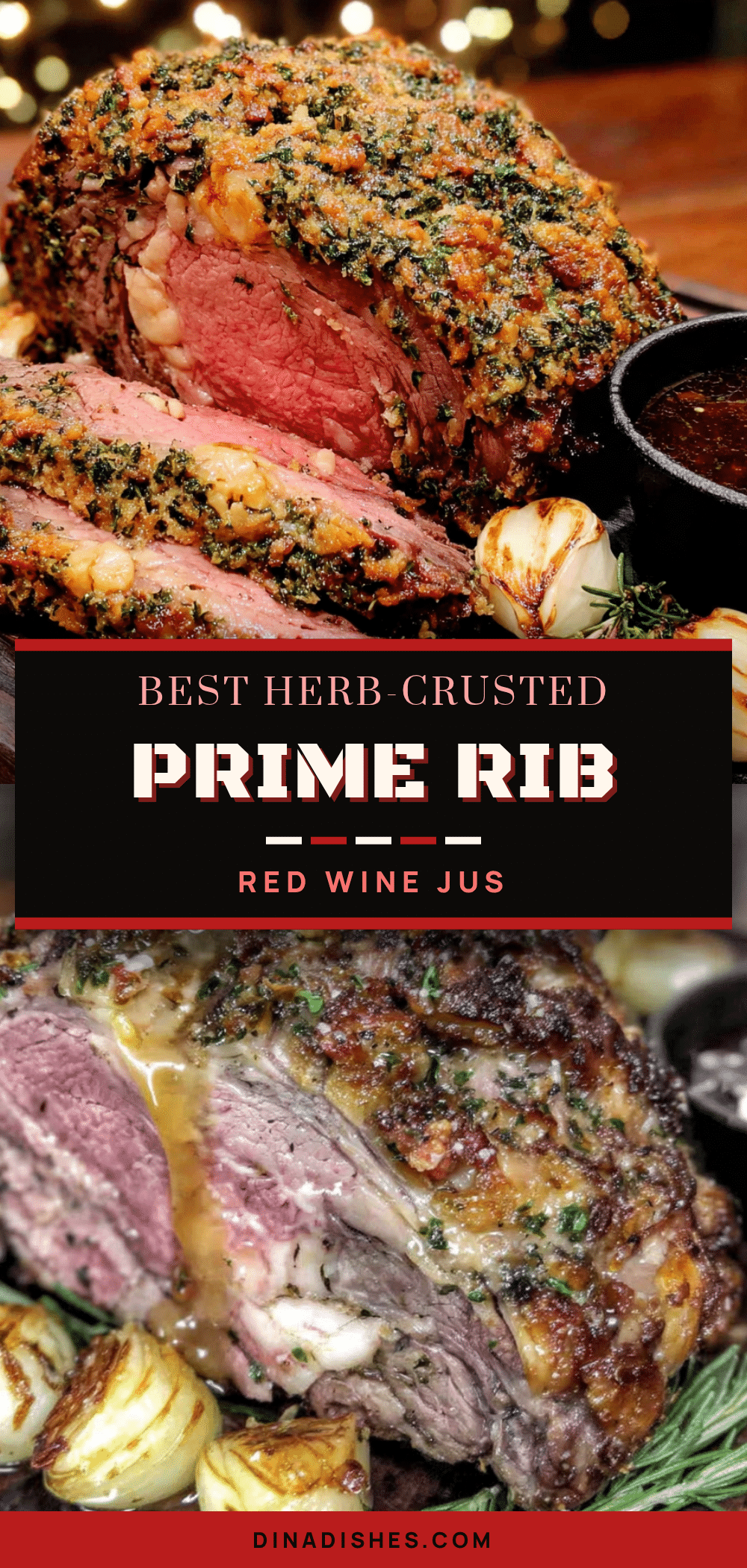
Best Herb-Crusted Prime Rib Roast with Red Wine Jus
This herb-crusted prime rib roast with red wine jus is a showstopper centerpiece that brings steakhouse magic home. With a foolproof herb crust, stress-free hosting, and a rich, silky jus, it’s perfect for holidays and special gatherings.
- Prep Time: 30 minutes
- Cook Time: 2 hours 45 minutes
- Total Time: 3 hours 45 minutes
- Yield: 8 servings 1x
- Category: Main Course
- Cuisine: American
Ingredients
- 1 (6-8 pound) bone-in prime rib roast (standing rib roast, first cut from large end)
- 2 tablespoons kosher salt (Diamond Crystal preferred)
- 1 tablespoon freshly cracked black pepper
- ¼ cup fresh rosemary, finely chopped (about 4–5 sprigs)
- ¼ cup fresh thyme leaves
- 2 tablespoons fresh oregano, chopped (optional)
- 6 cloves garlic, minced
- 3 tablespoons olive oil (extra virgin)
- 2 cups dry red wine (Cabernet Sauvignon or Merlot)
- 2 cups low-sodium beef broth (Better Than Bouillon roasted beef base recommended)
- 1 small shallot, finely diced (about 2 tablespoons)
- 2 tablespoons unsalted butter, cold, cut into small cubes
- 1 tablespoon all-purpose flour (optional, for thicker jus)
- Fresh thyme sprigs and rosemary sprig (for infusing jus)
- Salt and pepper to taste
Instructions
- Remove the prime rib from the fridge and let it sit on the counter for 2 hours to come to room temperature. Pat it completely dry with paper towels. Using a sharp knife, score the fat cap in a crosshatch pattern, cutting about ¼ inch deep.
- In a small bowl, combine the chopped rosemary, thyme, oregano, minced garlic, olive oil, kosher salt, and black pepper. Mix into a paste. Rub this mixture all over the roast, pressing it firmly into the scored fat cap and all sides. Place the roast bone-side down on a rack in a roasting pan. Tie it with kitchen twine between each bone.
- Preheat the oven to 275°F (135°C). Roast the prime rib until the internal temperature reaches 115°F (46°C) for rare, or 125°F (52°C) for medium-rare. Start checking at the 2-hour mark. Insert the thermometer into the center, away from the bone.
- Once the roast hits your target temperature, remove it from the oven. Increase the oven temperature to 500°F (260°C). While it’s heating, tent the roast loosely with foil. After the oven reaches 500°F, remove the foil and return the roast to the oven. Roast for 10-15 minutes, until the crust is deep golden brown and crackling.
- Remove the roast from the oven and transfer it to a cutting board. Tent it loosely with foil and let it rest for at least 20 minutes. The internal temperature will rise another 5-10°F during resting.
- While the roast rests, place the roasting pan on the stovetop over medium heat. Add the diced shallot and cook for 1-2 minutes, scraping up the browned bits. Pour in the red wine and bring to a simmer. Let it reduce by half, about 5 minutes. Add the beef broth and the herb sprigs. Simmer for another 5 minutes. Strain the jus through a fine-mesh sieve into a small saucepan. Whisk in the cold butter, one cube at a time, until glossy and slightly thickened. Season with salt and pepper to taste.
- Remove the twine and slice between the bones to separate the roast into individual ribs. Then slice the meat against the grain into ½-inch thick pieces. Arrange on a platter, spoon some of the red wine jus over the top, and serve the remaining jus on the side.
Notes
Let the meat come to room temperature before roasting for even cooking. Scoring the fat cap deeply helps the herb crust penetrate. Use a thermometer, not a timer, for perfect doneness. Resting the roast for 20-30 minutes is essential for tenderness. For the jus, let the wine reduce until syrupy to avoid bitterness. Plan your timing backward from when guests arrive.
Nutrition
- Serving Size: 6 ounces with 2 tabl
- Calories: 520
- Sugar: 1
- Sodium: 480
- Fat: 38
- Saturated Fat: 15
- Carbohydrates: 3
- Protein: 45
Keywords: prime rib, herb crust, red wine jus, standing rib roast, holiday roast, beef roast, Christmas dinner, special occasion