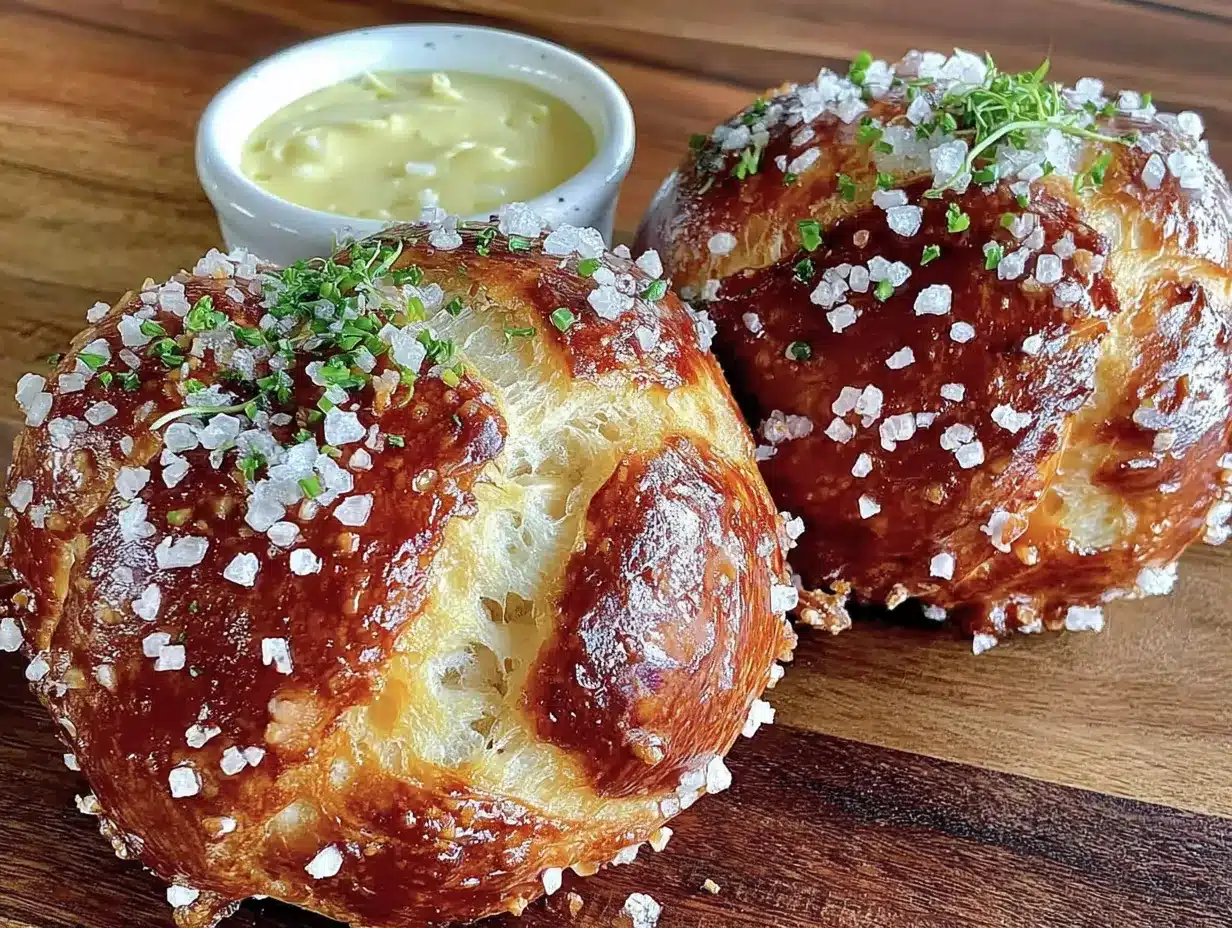
It was 11:47 PM on a rainy Tuesday, and I was hit with the weirdest craving for a mall pretzel. You know the ones—warm, salty, impossibly soft in the middle, and chewy on the outside. But here’s the thing: I didn’t have any of that fake butter spray or those suspiciously orange cheese dips. What I did have was a bag of bread flour, a box of baking soda, and this wild idea that maybe, just maybe, I could make something better than the mall version. My kitchen looked like a science experiment gone wrong by midnight, but when I pulled those golden-brown rolls out of the oven at 1 AM, I knew I’d stumbled onto something special. The whole house smelled like a German bakery, and I stood there eating one straight from the baking sheet, butter dripping down my wrist, thinking, “Why don’t I make these every week?” Honestly, that late-night impulse led to my family’s most-requested recipe. These soft Bavarian pretzel rolls have that perfect balance—a deeply browned, slightly crisp exterior giving way to a pillowy, tender center that practically begs for a slather of mustard butter. They’re the kind of rolls that disappear before you can even say “bitte schön.”
Why You’ll Love This Recipe
Let me tell you why these pretzel rolls have become a staple in my kitchen. After testing this recipe at least a dozen times (and burning my fingers on hot baking soda water more times than I’d like to admit), I can confidently say this version works every single time.
- Budget-Friendly Baking: These rolls cost pennies to make compared to bakery prices. A bag of flour and some yeast go a long way when you’re feeding a hungry family.
- Simple Ingredients: No fancy malt syrup or food-grade lye required. You probably have everything in your pantry right now except maybe the pretzel salt.
- Family-Approved: My kids, who normally pick at dinner rolls, devour these before the mustard butter even hits the table. Even my picky nephew asked for seconds.
- Freezer-Friendly: Make a double batch on Sunday, freeze half, and you’ve got homemade rolls ready for busy weeknights or surprise guests.
- Impressive Without Stress: These look like you spent hours in a professional bakery, but the active work time is maybe 20 minutes. The rest is just waiting for dough to rise.
What makes these different from every other pretzel roll recipe out there? It’s the texture, plain and simple. I spent months perfecting the ratio of bread flour to all-purpose flour, tweaking the baking soda bath time, and figuring out the exact oven temperature that gives you that deep mahogany crust without drying out the inside. These rolls have that unmistakable chew of a proper Bavarian pretzel, but they stay soft and fluffy for days—not something you can say about most homemade versions.
There’s something about pulling a batch of these out of the oven that makes you feel like a rockstar in your own kitchen. The smell alone will bring everyone running, and watching them fight over the last roll is honestly one of my favorite things. This isn’t just bread—it’s the kind of food that makes ordinary dinners feel like something special.
What Ingredients You Will Need
This recipe keeps things simple with mostly pantry staples. The magic happens through technique, not fancy ingredients.
- Bread flour, 4 cups (500g) – This gives the rolls their signature chew. All-purpose flour works in a pinch, but bread flour really makes a difference in texture. I prefer King Arthur or Bob’s Red Mill for consistent results.
- Warm water, 1½ cups (355ml) – Should feel like warm bath water, about 110°F. Too hot will kill the yeast, too cold and the dough won’t rise properly.
- Active dry yeast, 2¼ teaspoons (one packet) – I’ve used instant yeast successfully too, just skip the proofing step and mix it directly with the flour.
- Brown sugar, 2 tablespoons (25g) – Adds a subtle sweetness and helps with browning. Regular granulated sugar works fine too.
- Unsalted butter, 2 tablespoons (28g), melted – Adds richness to the dough. Salted butter works if you reduce the added salt slightly.
- Salt, 1½ teaspoons (9g) – I use fine sea salt for the dough. Don’t skip this—pretzel dough needs enough salt to balance the flavor.
- Baking soda, ½ cup (120g) – This is for the boiling bath. Yes, that’s a lot of baking soda, but it’s what gives pretzels their signature dark crust and unique flavor.
- Water for boiling bath, 10 cups (2.4 liters) – Use a large pot so the rolls have room to float.
- Egg wash: 1 large egg + 1 tablespoon water – Gives the rolls that glossy, professional finish.
- Coarse pretzel salt, for sprinkling – Regular table salt won’t give the same effect. Look for pretzel salt or use flaky sea salt in a pinch.
For the Mustard Butter:
- Unsalted butter, ½ cup (113g), softened – Let it sit out for 30 minutes before mixing.
- Whole grain mustard, 2 tablespoons (30g) – I love the texture of whole grain, but Dijon works beautifully too.
- Honey, 1 tablespoon (15ml) – Balances the mustard’s sharpness. Maple syrup is a great substitute.
- Garlic powder, ½ teaspoon – Optional, but I never skip it.
- Fresh parsley, 1 tablespoon, chopped – Adds color and freshness. Dried parsley works in a pinch.
Equipment Needed
You don’t need much to make these rolls, which is part of their charm. Here’s what you’ll want on hand:
- Large mixing bowl – Glass or stainless steel works best. Plastic can absorb odors.
- Stand mixer with dough hook – Makes kneading effortless, but your hands work just fine. I actually prefer kneading by hand when I’m feeling stressed—it’s therapeutic.
- Large pot (at least 6 quarts) – You need enough room for the rolls to float in the baking soda bath without crowding.
- Slotted spoon or spider strainer – For lifting the rolls out of the boiling water. A regular spoon works, but a spider is much easier.
- Baking sheets lined with parchment paper – Parchment is non-negotiable here. The baking soda residue can stick to foil or unlined pans.
- Sharp knife or bread lame – For scoring the tops before baking. A clean razor blade works great too.
- Pastry brush – For the egg wash. A silicone brush is easiest to clean.
- Kitchen scale – Not required, but measuring flour by weight gives the most consistent results. I resisted getting one for years, and now I use it for everything.
Preparation Method
Let’s walk through this step by step. I’ll tell you exactly what to look for at each stage so you know you’re on the right track.
- Proof the yeast: In your mixing bowl, combine the warm water and brown sugar. Sprinkle the yeast on top and let it sit for 5-7 minutes until it gets foamy. If nothing happens after 10 minutes, your yeast might be dead—start over with fresh yeast. It happens to everyone at some point.
- Mix the dough: Add the melted butter, salt, and 2 cups of bread flour to the yeast mixture. Stir until combined, then gradually add the remaining flour, ½ cup at a time. The dough will look shaggy at first—don’t panic. Keep mixing until it comes together into a rough ball.
- Knead the dough: Turn the dough onto a lightly floured surface and knead for 8-10 minutes (or 5-6 minutes in a stand mixer on medium speed). The dough should be smooth, elastic, and slightly tacky but not sticky. If it’s sticking to your hands like crazy, add a tablespoon of flour at a time. If it feels dry and stiff, add a splash of water. You’re looking for that “baby’s bottom” smoothness—trust me, you’ll know it when you feel it.
- First rise: Place the dough in a lightly greased bowl, cover with plastic wrap or a damp kitchen towel, and let it rise in a warm spot for 1-1½ hours, until doubled in size. I usually put mine in the microwave (turned off, obviously) with a cup of hot water next to it. The steam and warmth create the perfect environment.
- Shape the rolls: Punch down the dough and divide it into 8 equal pieces (about 110g each if you’re weighing). Shape each piece into a smooth ball by pulling the edges down and pinching them together at the bottom. Place seam-side down on a parchment-lined baking sheet, cover loosely, and let rest for 15 minutes. This relaxes the gluten so they don’t shrink in the bath.
- Prepare the baking soda bath: While the rolls rest, bring 10 cups of water to a boil in your large pot. Carefully add the baking soda—it will foam up dramatically, so add it slowly. Reduce the heat to a gentle simmer. Important safety note: don’t use aluminum pots for this, as the baking soda will react with the metal and turn your rolls gray.
- Boil the rolls: Gently lower 2-3 rolls at a time into the simmering water. Boil for 30 seconds on each side (60 seconds total). Use your slotted spoon to flip them. They’ll puff up slightly and develop a skin. Don’t overcrowd the pot—they need room to float. I learned this the hard way when I tried to boil six at once and they all stuck together like some kind of pretzel blob.
- Drain and arrange: Use your slotted spoon to transfer the boiled rolls back to the parchment-lined baking sheet, spacing them about 2 inches apart. Let them drain for a minute before brushing with egg wash.
- Score and salt: Brush each roll generously with egg wash. Using a sharp knife, cut a deep “X” or a single slash across the top of each roll—about ½ inch deep. Sprinkle generously with coarse pretzel salt. Don’t be shy with the salt; it’s what makes them taste like real pretzels.
- Bake: Preheat your oven to 425°F (220°C) and bake the rolls for 15-18 minutes, rotating the pan halfway through. They’re done when they’re deep golden brown and sound hollow when tapped on the bottom. The kitchen will smell absolutely incredible at this point.
- Cool and enjoy: Let the rolls cool on the baking sheet for 5 minutes, then transfer to a wire rack. They’re best eaten warm, but honestly, they’re pretty amazing at room temperature too.
Cooking Tips & Techniques
After making these rolls more times than I can count, I’ve picked up a few tricks that make a real difference.
Don’t skip the boiling step. I know it seems fussy, but this is what gives pretzels their unique texture and flavor. The baking soda bath gelatinizes the starch on the outside of the dough, creating that chewy skin that makes pretzels so satisfying. Skip it, and you’ve just made regular bread rolls. Not bad, but not pretzels.
Watch your water temperature. If the water is too hot, the rolls will cook on the outside before they’ve had time to develop that proper skin. Too cold, and they won’t get that distinctive pretzel crust. A gentle simmer is perfect—you should see small bubbles rising but not a rolling boil.
Let the dough rest after shaping. This is one of those steps I used to skip when I was in a hurry, and my rolls always came out misshapen and dense. That 15-minute rest lets the gluten relax so the rolls hold their shape during boiling. Trust me on this one.
Use a kitchen scale. I resisted this for years, but weighing your ingredients gives you perfectly consistent results every time. Flour measurement by volume can vary wildly depending on how you scoop it. A $15 scale will change your baking game completely.
Don’t over-boil. Thirty seconds per side is plenty. Any longer and the rolls can develop a weird, rubbery texture. I made this mistake once and ended up with pretzel rolls that bounced like tennis balls. Not my finest moment.
Make ahead tip: You can prepare the dough through step 4 and let it rise in the refrigerator overnight. The slow fermentation actually develops better flavor. Just bring it to room temperature before shaping and boiling.
Variations & Adaptations
These pretzel rolls are incredibly versatile. Here are some ways I’ve adapted them for different cravings and dietary needs:
Cheesy Pretzel Rolls
Before shaping each roll, flatten the dough ball and place a cube of sharp cheddar or pepper jack in the center. Pinch the edges to seal, then proceed with boiling and baking. The cheese gets melty and amazing inside. My kids beg for these.
Everything Bagel Pretzel Rolls
After brushing with egg wash, sprinkle with everything bagel seasoning instead of pretzel salt. The sesame seeds, poppy seeds, garlic, and onion flakes add incredible flavor. These are dangerous—I can never eat just one.
Gluten-Free Version
I’ve tested this with a good quality gluten-free flour blend (one that contains xanthan gum) and it works surprisingly well. The texture is slightly different—less chewy, more tender—but still delicious. Add an extra tablespoon of water to the dough since gluten-free flours absorb more liquid.
Mini Slider Rolls
Divide the dough into 16 pieces instead of 8 and reduce the boiling time to 20 seconds per side. Bake for 12-14 minutes. These make incredible little sandwiches for parties or lunchboxes.
Whole Wheat Version
Substitute half the bread flour with whole wheat flour. The rolls will be denser and nuttier, but still delicious. You might need to add an extra tablespoon or two of water since whole wheat flour absorbs more moisture.
Serving & Storage Suggestions
These rolls are best served warm, ideally within an hour of baking. That’s when the crust is perfectly crisp and the inside is pillowy soft. But let’s be real—they’re pretty amazing at any temperature.
Serving ideas: Split them open and slather with the mustard butter while they’re still warm. They’re incredible alongside a big bowl of hearty soup, as sandwich rolls for bratwurst or pulled pork, or just eaten plain with a cold beer. For breakfast, try them split, toasted, and spread with butter and jam—trust me on this.
Storage: Keep leftover rolls in an airtight container at room temperature for up to 3 days. Don’t refrigerate them—the fridge actually makes bread go stale faster. If they start to dry out, wrap them in a damp paper towel and microwave for 15 seconds. They’ll be almost as good as fresh.
Freezing: These freeze beautifully. Let them cool completely, then wrap individually in plastic wrap and place in a freezer bag. They’ll keep for up to 3 months. To reheat, unwrap and bake at 350°F for 10 minutes, or microwave for 30 seconds if you’re in a hurry.
Make the mustard butter ahead: The mustard butter can be made up to a week in advance and stored in the fridge. Let it come to room temperature before serving so it’s spreadable. It’s also amazing on roasted vegetables or grilled chicken.
Nutritional Information & Benefits
Per serving (1 roll with 1 tablespoon mustard butter):
- Calories: 285
- Total Fat: 12g
- Saturated Fat: 7g
- Carbohydrates: 36g
- Fiber: 2g
- Sugar: 4g
- Protein: 8g
- Sodium: 680mg
These rolls are made with simple, real ingredients—no preservatives, no artificial flavors, nothing you can’t pronounce. The bread flour provides complex carbohydrates for steady energy, and the butter adds a touch of healthy fat. The mustard in the compound butter contains turmeric, which has anti-inflammatory properties. Plus, making bread from scratch means you control exactly what goes into your food. That’s something I feel good about feeding my family.
If you’re watching your sodium, you can reduce the pretzel salt on top or use a low-sodium alternative. The rolls themselves aren’t overly salty—it’s really just the topping that adds the salt punch.
Conclusion
These soft Bavarian pretzel rolls have become a beloved staple in my kitchen, and I have a feeling they’ll become one in yours too. They’re the kind of recipe that makes you feel like a hero—simple enough for a Tuesday night, impressive enough for company, and delicious enough that everyone asks for the recipe.
What I love most about these rolls is how they bring people together. There’s something about the smell of freshly baked pretzels that makes everyone gather in the kitchen, reaching for warm rolls and slathering them with mustard butter. It’s comfort food at its finest—humble, honest, and absolutely delicious.
I’d love to hear how these turn out for you! Did you try any of the variations? Did your family fight over the last roll like mine does? Drop a comment below and let me know. And if you loved this recipe, share it with a friend who needs a little homemade happiness in their life.
Happy baking, friends! Your kitchen is about to smell amazing.
Frequently Asked Questions
Can I use all-purpose flour instead of bread flour?
Yes, but the texture will be slightly less chewy. Bread flour has more protein, which creates more gluten and gives pretzels their signature chew. If you only have all-purpose flour, your rolls will still be delicious—just a bit softer and more like dinner rolls than authentic pretzels.
Why did my pretzel rolls turn out pale?
This usually happens for one of three reasons: the baking soda bath wasn’t concentrated enough, the rolls weren’t boiled long enough, or your oven temperature was too low. Make sure you’re using the full ½ cup of baking soda and boiling for the full 30 seconds per side. Also, check your oven temperature with an oven thermometer—many run cooler than they say.
Can I make the dough in a bread machine?
Absolutely! Use the dough cycle and let the machine do the kneading and first rise. When the cycle finishes, shape the rolls and proceed with the boiling and baking steps. This is a great time-saver for busy weeknights.
How do I get that deep brown color without using lye?
The baking soda bath is the key. Some recipes use food-grade lye for an even darker crust, but baking soda works beautifully and is much safer for home kitchens. For an even darker color, add 1 teaspoon of sugar to the boiling water—it helps with browning. Also, don’t skimp on the egg wash; it’s what gives the rolls that gorgeous glossy finish.
My rolls came out dense and heavy. What went wrong?
This usually means the dough wasn’t kneaded enough to develop gluten, or it was over-floured during shaping. Next time, weigh your flour instead of measuring by volume, and make sure you’re kneading until the dough is smooth and elastic. Also, check that your yeast is fresh and active—dead yeast won’t give you the rise you need.
Pin This Recipe!
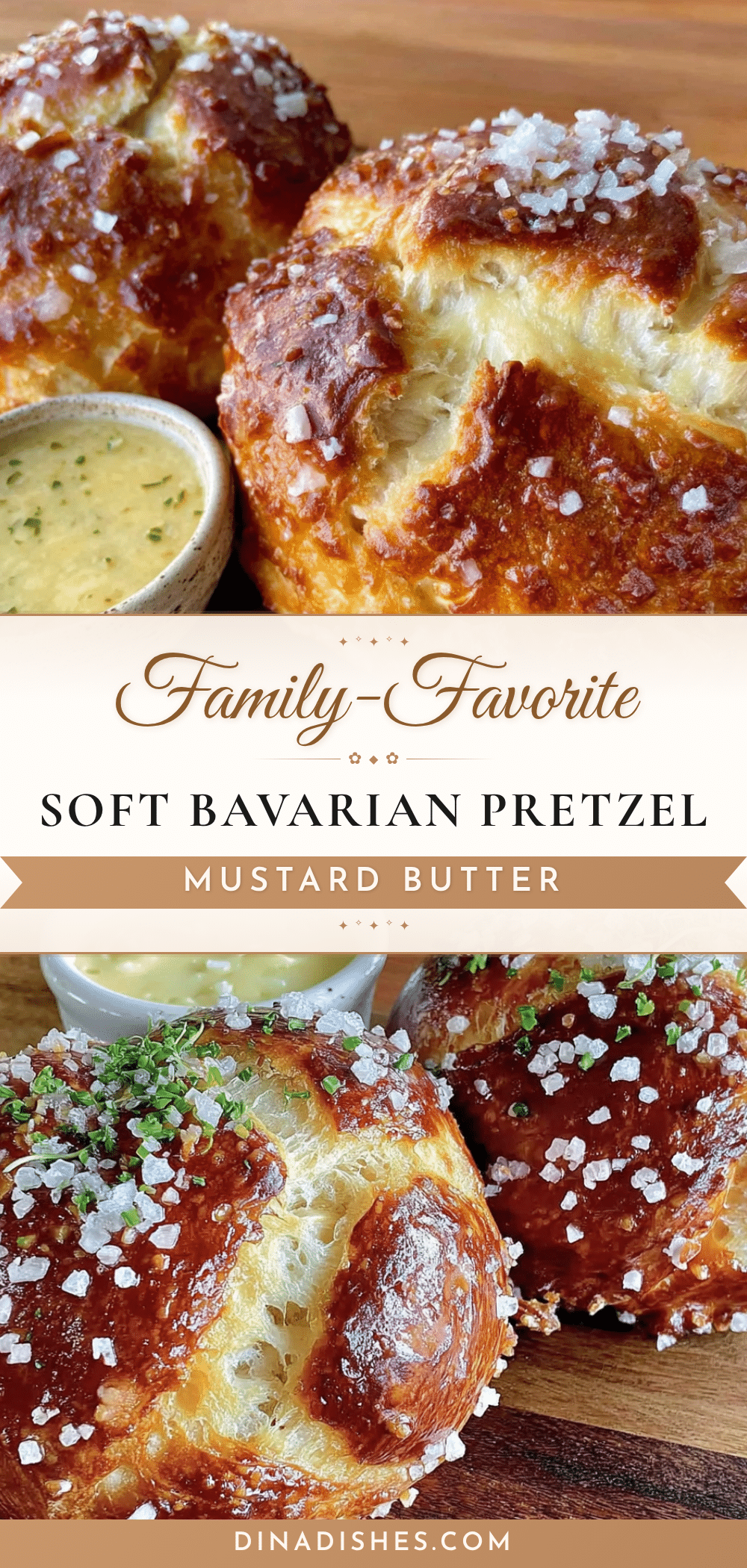
Best Homemade Soft Bavarian Pretzel Rolls with Mustard Butter

These soft Bavarian pretzel rolls have a deeply browned, slightly crisp exterior and a pillowy, tender center. They’re perfect with a slather of mustard butter and are a family-favorite recipe that’s budget-friendly and made with simple ingredients.
- Prep Time: 20 minutes
- Cook Time: 18 minutes
- Total Time: 2 hours 8 minutes (including rising time)
- Yield: 8 servings 1x
- Category: Bread
- Cuisine: German
Ingredients
- 4 cups (500g) bread flour
- 1½ cups (355ml) warm water (about 110°F)
- 2¼ teaspoons (one packet) active dry yeast
- 2 tablespoons (25g) brown sugar
- 2 tablespoons (28g) unsalted butter, melted
- 1½ teaspoons (9g) fine sea salt
- ½ cup (120g) baking soda (for boiling bath)
- 10 cups (2.4 liters) water (for boiling bath)
- 1 large egg + 1 tablespoon water (for egg wash)
- Coarse pretzel salt, for sprinkling
- For the Mustard Butter:
- ½ cup (113g) unsalted butter, softened
- 2 tablespoons (30g) whole grain mustard
- 1 tablespoon (15ml) honey
- ½ teaspoon garlic powder
- 1 tablespoon fresh parsley, chopped
Instructions
- Proof the yeast: In your mixing bowl, combine the warm water and brown sugar. Sprinkle the yeast on top and let it sit for 5-7 minutes until it gets foamy.
- Mix the dough: Add the melted butter, salt, and 2 cups of bread flour to the yeast mixture. Stir until combined, then gradually add the remaining flour, ½ cup at a time, until the dough comes together into a rough ball.
- Knead the dough: Turn the dough onto a lightly floured surface and knead for 8-10 minutes (or 5-6 minutes in a stand mixer on medium speed) until smooth, elastic, and slightly tacky but not sticky.
- First rise: Place the dough in a lightly greased bowl, cover, and let it rise in a warm spot for 1-1½ hours until doubled in size.
- Shape the rolls: Punch down the dough and divide it into 8 equal pieces (about 110g each). Shape each piece into a smooth ball, place seam-side down on a parchment-lined baking sheet, cover loosely, and let rest for 15 minutes.
- Prepare the baking soda bath: Bring 10 cups of water to a boil in a large pot. Carefully add the baking soda (it will foam up), then reduce the heat to a gentle simmer.
- Boil the rolls: Gently lower 2-3 rolls at a time into the simmering water. Boil for 30 seconds on each side (60 seconds total). Use a slotted spoon to flip them.
- Drain and arrange: Transfer the boiled rolls back to the parchment-lined baking sheet, spacing them about 2 inches apart. Let them drain for a minute.
- Score and salt: Brush each roll generously with egg wash. Using a sharp knife, cut a deep ‘X’ or a single slash across the top of each roll (about ½ inch deep). Sprinkle generously with coarse pretzel salt.
- Bake: Preheat oven to 425°F (220°C). Bake the rolls for 15-18 minutes, rotating the pan halfway through, until deep golden brown and they sound hollow when tapped on the bottom.
- Cool and enjoy: Let the rolls cool on the baking sheet for 5 minutes, then transfer to a wire rack. Serve warm.
Notes
Don’t skip the boiling step—it gives pretzels their unique texture and flavor. Use a gentle simmer, not a rolling boil. Let the dough rest after shaping to prevent shrinkage. For make-ahead, refrigerate the dough overnight after the first rise. Freeze cooled rolls for up to 3 months.
Nutrition
- Serving Size: 1 roll with 1 tables
- Calories: 285
- Sugar: 4
- Sodium: 680
- Fat: 12
- Saturated Fat: 7
- Carbohydrates: 36
- Fiber: 2
- Protein: 8
Keywords: pretzel rolls, Bavarian pretzel, soft pretzel, homemade pretzel, mustard butter, German bread, pretzel recipe