I was staring at the meat counter at Costco, completely frozen. Not because the refrigerated air was getting to me, but because that massive prime rib roast was staring right back, and I had no idea what to do with it. My neighbor Gladys, a retired caterer who’s been cooking since before I was born, watched me from the cheese aisle for a solid minute before she finally wheeled her cart over.
“You keep looking at that roast like it’s going to jump out and cook itself,” she said, not unkindly. “Put it in the cart. Come over tomorrow morning. I’ll show you.”
And just like that, the best garlic herb butter prime rib roast became my go-to for feeding a crowd. Gladys didn’t hand me a recipe card or tell me to write anything down. She just talked while she worked, her hands moving with the kind of confidence that only comes from decades of practice. “You don’t need fancy techniques,” she said, rubbing butter into the meat like she was giving it a good massage. “You need patience and a decent thermometer.”
I took notes on a napkin that day, and honestly, I’ve been making this recipe ever since. There’s something about a prime rib roast that feels intimidating, but once you break it down, it’s actually one of the simplest things you can cook for a crowd. Maybe you’ve been there too, standing in the grocery store, wondering if you’re about to ruin a very expensive piece of meat. Let me tell you, with this method, you won’t.
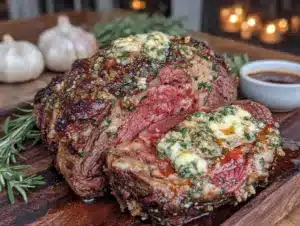
The garlic herb butter does all the heavy lifting here. It creates this incredible crust on the outside while the inside stays perfectly pink and tender. I’ve made this for Christmas dinners, birthday celebrations, and random Tuesday nights when I just felt like having leftovers for a week. Every single time, it works.
Why You’ll Love This Recipe
This isn’t just another prime rib recipe. After testing this method more times than I care to count, I can tell you exactly why this one works better than the rest. The garlic herb butter prime rib roast is the kind of recipe that makes you look like a professional chef without all the stress.
- Feeds a Crowd Without Breaking the Bank : One roast can easily serve 8-10 people, and the leftovers are even better the next day. When you’re feeding a family on a sensible budget, getting multiple meals from one roast is a game-changer.
- Simple Ingredients, Big Flavor : You don’t need a dozen exotic spices or hard-to-find ingredients. Fresh garlic, butter, rosemary, and thyme are all you really need. These are things most home cooks already have in their kitchen.
- Picky Eater Approved : Even my kids, who usually turn their noses up at anything that isn’t chicken nuggets, ask for seconds of this roast. The garlic herb butter keeps the meat incredibly moist and flavorful without being overpowering.
- Make-Ahead Friendly : You can prep the garlic herb butter days in advance, rub it on the roast, and let it sit in the fridge until you’re ready to cook. This makes holiday hosting so much less stressful.
- Leftovers That Reheat Beautifully : Unlike some roasts that turn into shoe leather the next day, this one stays tender and juicy. Slice it thin for sandwiches, chop it into hash, or just reheat slices in a hot pan with a little butter.
What makes this recipe different from all the others is the technique Gladys taught me. Most people either sear the roast first or cook it low and slow the whole time. This method combines both approaches in a way that gives you a perfect crust and a perfectly cooked interior every single time. No dry edges, no raw center, just consistent, beautiful results.
Honestly, this is the recipe that made me stop being afraid of cooking expensive cuts of meat. It’s comfort food at its finest, but with a little more elegance than your average Sunday roast. The kind of meal that makes everyone at the table close their eyes after the first bite.
What Ingredients You Will Need
This recipe uses simple, wholesome ingredients to deliver bold flavor and satisfying texture without the fuss. Most of these are pantry staples, which is exactly what you want when you’re planning a big meal.
For the Garlic Herb Butter
- 1 cup unsalted butter, softened (2 sticks, 8 oz or 226g) – Make sure it’s really soft, almost like mayonnaise consistency. Cold butter won’t spread properly over the roast.
- 8 cloves garlic, minced (about 2 tablespoons or 30ml) – Fresh garlic is non-negotiable here. The jarred stuff just doesn’t have the same punch.
- 2 tablespoons fresh rosemary, finely chopped (about 6g) – I prefer fresh over dried for this recipe. The flavor is more aromatic and less piney.
- 2 tablespoons fresh thyme leaves (about 4g) – Strip the leaves from the stems. Nobody wants to pick woody stems out of their butter.
- 1 tablespoon fresh parsley, finely chopped (about 3g) – Adds a nice freshness to balance the rich butter.
- 2 teaspoons kosher salt (10g) – I use Diamond Crystal. If you’re using table salt, cut it back to 1 teaspoon.
- 1 teaspoon black pepper, freshly ground (2g) – Fresh ground makes a difference. Pre-ground pepper is too dusty and lacks punch.
- 1 teaspoon onion powder (2g) – Optional, but I find it rounds out the garlic flavor nicely.
For the Prime Rib Roast
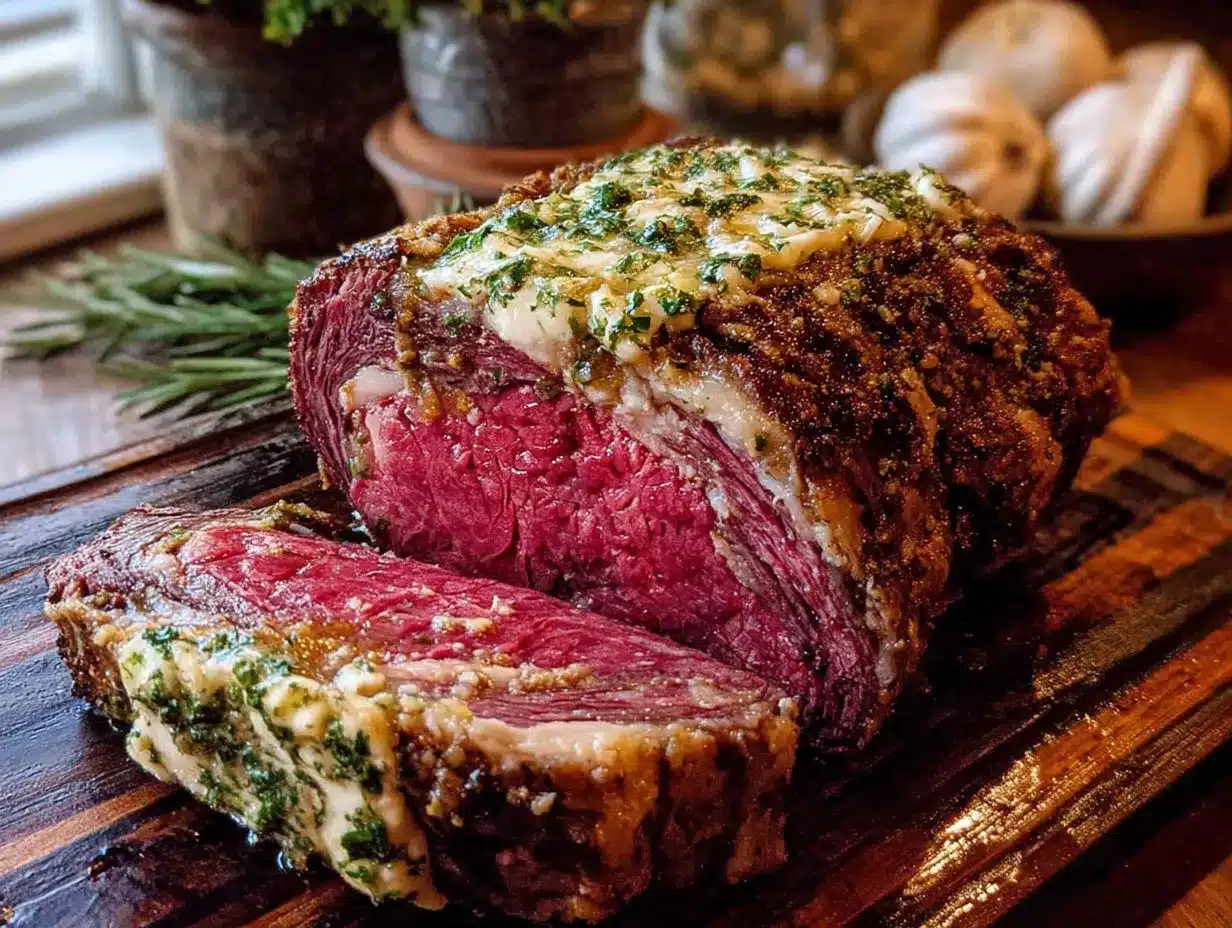
- 1 bone-in prime rib roast, 7-8 pounds (3.2-3.6 kg) – This size feeds 8-10 people comfortably. If you’re feeding more, adjust the cooking time accordingly.
- Additional kosher salt for seasoning (about 1 tablespoon or 15g) – Don’t skip this step. The salt helps form that beautiful crust.
- Fresh cracked black pepper (about 1 teaspoon or 2g) – Go heavy on this. The pepper adds warmth and depth.
For the Au Jus (Optional but Recommended)
- 2 cups beef broth (480ml) – Use low-sodium so you can control the salt level.
- 1/4 cup dry red wine (60ml) – Merlot or Cabernet work well. If you don’t cook with wine, just use extra broth.
- 2 tablespoons pan drippings (from the roast) – This is where all the flavor lives.
- 1 teaspoon Worcestershire sauce (5ml) – Adds that umami depth we all love.
- 1 tablespoon cornstarch mixed with 2 tablespoons cold water (optional, for thickening) – Only if you like a thicker gravy.
Ingredient Tips from My Kitchen
I always use Kerrygold butter for this recipe. It has a higher fat content than standard American butter, which means it’s richer and more flavorful. If you’re watching your salt intake, use unsalted butter and adjust the salt yourself. You have more control that way.
For the garlic, I recommend using a microplane instead of mincing by hand. It creates a paste that incorporates into the butter more evenly. Just be careful not to grate your knuckles. Trust me, I’ve done it more times than I care to admit.
If fresh herbs aren’t available, you can substitute dried, but use about one-third the amount. Dried herbs are more concentrated, so 2 teaspoons dried rosemary and 2 teaspoons dried thyme would work here. Just know the flavor won’t be quite as bright.
Equipment Needed
You don’t need a professional kitchen to make this garlic herb butter prime rib roast. Here’s what you’ll actually use:
- Large roasting pan with a rack – The rack keeps the roast elevated so heat circulates evenly. If you don’t have a rack, you can use rolled-up foil strips or celery stalks as a makeshift rack. I’ve done both in a pinch.
- Instant-read meat thermometer – This is absolutely essential. Guessing the doneness of a prime rib is a recipe for disaster. I use a Thermapen, but any reliable instant-read thermometer will work.
- Mixing bowl – For combining the garlic herb butter ingredients.
- Chef’s knife and cutting board – For mincing garlic and chopping herbs.
- Kitchen twine – If your roast isn’t already tied, you’ll need this to secure it. Most butchers will tie it for you if you ask.
- Aluminum foil – For tenting the roast while it rests. This step is non-negotiable.
- Small saucepan – For making the au jus, if you’re going that route.
- Carving knife – A long, sharp knife makes slicing the roast much easier. A serrated knife works too, but a straight edge gives cleaner cuts.
I bought my roasting pan at a thrift store for eight dollars, and it’s been going strong for years. You don’t need expensive equipment. You just need the right tools for the job.
Preparation Method
Step 1: Make the Garlic Herb Butter
Start by taking your butter out of the fridge about an hour before you plan to make this. You want it soft enough that you can easily press your finger into it. While the butter softens, mince your garlic and chop your herbs.
In a medium mixing bowl, combine the softened butter, minced garlic, rosemary, thyme, parsley, kosher salt, black pepper, and onion powder. Mix everything together with a rubber spatula until it’s well combined. You’re looking for a uniform green-flecked butter with all the ingredients evenly distributed.
Taste the butter on a piece of bread to check the seasoning. It should be flavorful but not overwhelmingly salty. Remember, some of that butter will drip off during cooking, so you want it well-seasoned.
Pro tip: You can make this butter up to 3 days in advance and keep it in the fridge. Let it come to room temperature before using so it spreads easily.
Step 2: Prepare the Roast
Take your prime rib roast out of the refrigerator 2-3 hours before you plan to cook it. This is really important. A cold roast will cook unevenly, with the outside overcooking before the center reaches the right temperature.
Pat the roast dry with paper towels. You want the surface as dry as possible so the butter sticks and the crust forms properly. If the roast is wet, the butter will just slide off.
Using your hands, rub the garlic herb butter all over the roast. Don’t be shy here. Cover every surface, including the ends and the sides between the bones. If your roast is tied, work the butter under the twine as best you can.
Once the butter is applied, sprinkle the entire roast with additional kosher salt and fresh cracked black pepper. The salt draws out moisture, which then evaporates, leaving behind a concentrated layer of flavor.
Step 3: The Initial High-Heat Sear
Preheat your oven to 450°F (232°C). Place the roast on a rack in your roasting pan, bone side down. The bones act as a natural rack, lifting the meat slightly off the bottom of the pan.
Roast the prime rib at 450°F for 20 minutes. This high heat creates that beautiful brown crust on the outside. You’ll smell the butter and garlic filling your kitchen, and the sizzling sound is incredibly satisfying.
After 20 minutes, reduce the oven temperature to 325°F (163°C). Do not open the oven door when you reduce the temperature. Just turn the dial and let the oven do its thing.
Step 4: Roast to Perfect Doneness
Continue roasting at 325°F until the internal temperature reaches your desired doneness. Here are the target temperatures:
- Rare: 120-125°F (49-52°C)
- Medium-Rare: 130-135°F (54-57°C) – This is what most people consider perfect for prime rib
- Medium: 140-145°F (60-63°C)
- Medium-Well: 150-155°F (66-68°C)
- Well Done: 160°F+ (71°C+) – Please don’t do this to a prime rib roast
For a 7-8 pound roast, you’re looking at about 2 to 2 1/2 hours total cooking time at 325°F after the initial sear. But honestly, don’t rely on time. Use your thermometer. Insert it into the thickest part of the roast, avoiding the bone. The temperature will rise about 5-10 degrees during resting, so pull the roast out when it’s about 5 degrees below your target.
My personal preference: I pull the roast at 125°F for medium-rare. By the time it rests, it climbs to a perfect 130-135°F. The meat is pink, juicy, and incredibly tender.
Step 5: Rest the Roast
This step is just as important as the cooking itself. Remove the roast from the oven and transfer it to a cutting board. Tent it loosely with aluminum foil and let it rest for at least 20-30 minutes. I usually let mine rest for a full 30 minutes while I make the au jus and finish the side dishes.
During resting, the juices redistribute throughout the meat. If you cut into it too soon, all those beautiful juices will run out onto the cutting board, leaving you with dry meat. Trust me, I learned this lesson the hard way.
Step 6: Make the Au Jus (Optional)
While the roast rests, pour the pan drippings through a fine-mesh strainer into a small saucepan. You should have about 1/4 to 1/2 cup of drippings. Skim off any excess fat if you want, though personally, I leave a little for flavor.
Add the beef broth, red wine, and Worcestershire sauce to the pan. Bring it to a simmer over medium heat, scraping up any browned bits from the bottom of the pan. Let it simmer for 5-7 minutes to reduce slightly and concentrate the flavors.
If you want a thicker gravy, whisk in the cornstarch slurry and simmer for another minute until it thickens. Taste and adjust seasoning with salt and pepper.
Pour the au jus through a strainer one more time before serving to catch any remaining solids. Serve it alongside the sliced roast.
Step 7: Carve and Serve
Remove the kitchen twine from the roast. Using a sharp carving knife, slice between the bones to separate them from the roast. Then slice the meat against the grain into 1/2-inch to 3/4-inch thick slices.
Arrange the slices on a warm platter and spoon a little au jus over the top. Serve the remaining au jus on the side.
Cooking Tips & Techniques
After making this garlic herb butter prime rib roast more times than I can count, I’ve collected a few tricks that make the process smoother and the results more consistent.
Let the roast come to room temperature. I can’t stress this enough. A cold roast straight from the fridge will give you an overcooked exterior and an undercooked center. I once rushed this step because guests were arriving early, and the roast came out medium-well on the outside and rare in the middle. It was edible, but not my best work.
Use a probe thermometer if you have one. The kind that stays in the meat while it cooks and connects to a monitor outside the oven is a game-changer. You can set it to alert you when the internal temperature reaches your target, which means you don’t have to keep opening the oven door. Every time you open the door, heat escapes, and your cooking time gets thrown off.
Don’t skip the resting period. I know it’s tempting to carve into that beautiful roast right away, especially when everyone is hungry and the kitchen smells amazing. But that 20-30 minute rest is what separates a good roast from a great one. Use that time to finish your sides, make the au jus, and set the table.
Salt the roast the night before. If you have time, season the roast with salt only (no butter yet) and leave it uncovered in the fridge overnight. This dry brining method draws moisture to the surface, which then evaporates, leaving behind a more concentrated flavor and a better crust. Add the garlic herb butter just before cooking.
Watch the temperature, not the clock. Ovens vary wildly. My neighbor’s oven runs 25 degrees hotter than mine. The only reliable way to know when your roast is done is with a thermometer. I ruined my first prime rib because I followed the timing in a recipe without checking the temperature. It came out medium-well, and I was so disappointed.
Let the carving knife do the work. Use a long, sharp knife and let the weight of the blade do the cutting. Don’t saw back and forth. Clean, smooth strokes give you neater slices and keep the meat from shredding.
Variations & Adaptations
This recipe is wonderfully adaptable. Here are some variations I’ve tried over the years:
Herb Swap: Not a fan of rosemary? Use oregano or sage instead. I made a version with fresh tarragon once, and it was fantastic with the garlic butter. Tarragon has this subtle anise flavor that pairs beautifully with beef.
Spicy Kick: Add 1-2 teaspoons of red pepper flakes or a minced chipotle pepper in adobo to the butter. The heat cuts through the richness of the roast and adds a whole new dimension. My brother-in-law loves this version.
Bone-In vs. Boneless: This recipe works with boneless roasts too, but the cooking time will be shorter. A boneless roast cooks faster because heat penetrates more easily without the bone acting as an insulator. Start checking the temperature about 30 minutes earlier than you would for a bone-in roast.
Herb Crust Variation: After applying the garlic herb butter, roll the roast in fresh breadcrumbs mixed with more chopped herbs. This creates an extra-crispy crust that’s absolutely divine. I did this for Christmas one year, and it was a huge hit.
Wine Pairing: If you’re making the au jus, try using a full-bodied red wine like a Cabernet Sauvignon or a Malbec. The tannins in the wine help balance the richness of the beef. If you don’t cook with wine, substitute with beef broth and a splash of balsamic vinegar.
Dietary Adaptations: For a dairy-free version, use vegan butter or olive oil instead of regular butter. The garlic and herbs still provide plenty of flavor. For a lower-sodium option, use unsalted butter and reduce the added salt. You can always add more salt at the table.
Serving & Storage Suggestions
This garlic herb butter prime rib roast is a showstopper on any table, but how you serve and store it makes a big difference.
Serving Temperature: Serve the roast warm, not hot. After resting, the internal temperature should be around 130-135°F for medium-rare. The au jus should be served hot on the side. I like to warm the serving platter in the oven for a few minutes before arranging the sliced meat.
Presentation: Arrange the sliced roast on a platter with the bones arranged around the edge for a rustic look. Garnish with fresh rosemary sprigs and thyme. A sprinkle of flaky sea salt right before serving adds a nice crunch and pop of flavor.
Complementary Dishes: This roast pairs beautifully with roasted potatoes, creamed spinach, Yorkshire pudding, or a simple green salad. For a complete meal, I usually serve it with roasted baby carrots and a horseradish cream sauce on the side.
Storage: Leftover prime rib should be cooled to room temperature, then wrapped tightly in foil or plastic wrap and stored in the refrigerator. It will keep for 3-4 days. The au jus can be stored separately in an airtight container for up to a week.
Reheating: The best way to reheat prime rib without drying it out is to place slices in a skillet with a little beef broth or au jus over medium-low heat. Cover the skillet and warm for 2-3 minutes per side. You can also reheat it in a 300°F oven, covered, for about 10 minutes. Avoid the microwave unless you’re okay with rubbery meat.
Freezing: You can freeze leftover prime rib for up to 3 months. Wrap individual portions tightly in plastic wrap, then foil, and place them in a freezer bag. Thaw in the refrigerator overnight before reheating. The texture won’t be quite as good as fresh, but it’s still delicious in sandwiches or hash.
Leftover Ideas: Slice leftover prime rib thin for French dip sandwiches. Dice it up for beef hash with potatoes and onions. Or just eat it cold straight from the fridge. I won’t judge.
Nutritional Information & Benefits
While prime rib isn’t exactly health food, it does have some nutritional benefits when enjoyed in moderation.
Estimated Nutritional Values (per 6 oz serving, without au jus):
- Calories: 450-500
- Protein: 35-40g
- Fat: 35-40g
- Saturated Fat: 15-18g
- Carbohydrates: 1-2g
- Sodium: 400-500mg (varies based on seasoning)
- Iron: 15% of daily value
- Vitamin B12: 80% of daily value
- Zinc: 30% of daily value
Health Benefits: Beef is an excellent source of high-quality protein, which is essential for muscle repair and growth. It’s also rich in B vitamins, particularly B12, which supports nerve function and red blood cell formation. The zinc in beef plays a role in immune function and wound healing.
Dietary Considerations: This recipe is naturally gluten-free and low-carb. For a keto-friendly meal, skip the au jus or use a sugar-free thickener. It’s also suitable for paleo diets if you use ghee instead of butter.
Allergen Information: This recipe contains dairy (butter). For a dairy-free version, use vegan butter or olive oil. The recipe is free from eggs, soy, nuts, and shellfish.
My Personal Take: I believe in balance. This roast is a special occasion meal, not an everyday thing. When you do indulge, use quality ingredients and enjoy every bite. The protein and nutrients make it a satisfying meal that keeps you full and happy.
Conclusion
This garlic herb butter prime rib roast has become my go-to recipe for feeding a crowd, and I think it deserves a spot in your kitchen too. It looks impressive, tastes incredible, and honestly, it’s easier than most people think.
The magic is in the butter. That combination of garlic, fresh herbs, and good-quality butter creates a crust that’s crispy and golden, while the inside stays tender and juicy. Every time I make this, I remember Gladys standing in her kitchen, talking about how cooking for people is one of the simplest ways to show love. She was right.
I hope you give this recipe a try, whether it’s for a holiday dinner, a birthday celebration, or just because you want to treat your family to something special. Don’t be afraid to make it your own. Swap the herbs, adjust the seasoning, or try a different wine in the au jus. The best recipes are the ones that become yours.
If you make this roast, I’d love to hear how it turned out. Leave a comment below and let me know what you served with it, or if you made any changes that worked well. And if you have questions, ask away. I’m always happy to help.
Now go preheat that oven. Your family is going to love this.
Frequently Asked Questions
Can I use a boneless prime rib roast for this recipe?
Yes, you can absolutely use a boneless roast. The cooking time will be shorter because heat penetrates more easily without the bone. Start checking the internal temperature about 30 minutes earlier than you would for a bone-in roast of the same weight.
How do I know when the prime rib is done without a thermometer?
Honestly, I wouldn’t recommend cooking a prime rib without a thermometer. It’s too expensive of a cut to guess. If you absolutely must, you can use the hand test, but it’s not reliable. A good instant-read thermometer costs about $15 and will save you from ruining a $50+ roast.
Can I prepare the garlic herb butter in advance?
Yes, you can make the butter up to 3 days ahead. Store it in an airtight container in the refrigerator. Let it come to room temperature for about 30 minutes before spreading it on the roast so it’s soft enough to work with.
What should I do if my roast is cooking too quickly?
If the roast is browning too fast or the internal temperature is climbing too quickly, reduce your oven temperature to 300°F (150°C). You can also tent the roast loosely with foil to slow down the browning. The key is to keep cooking until it reaches the right internal temperature, even if it takes longer than expected.
How do I get a crispy crust on my prime rib?
The initial high-heat sear at 450°F is what creates the crust. Make sure your roast is patted completely dry before applying the butter, and don’t skip the resting period after cooking. For an extra-crispy crust, you can finish the roast under the broiler for 2-3 minutes after it’s done cooking, but watch it carefully so it doesn’t burn.
Pin This Recipe!
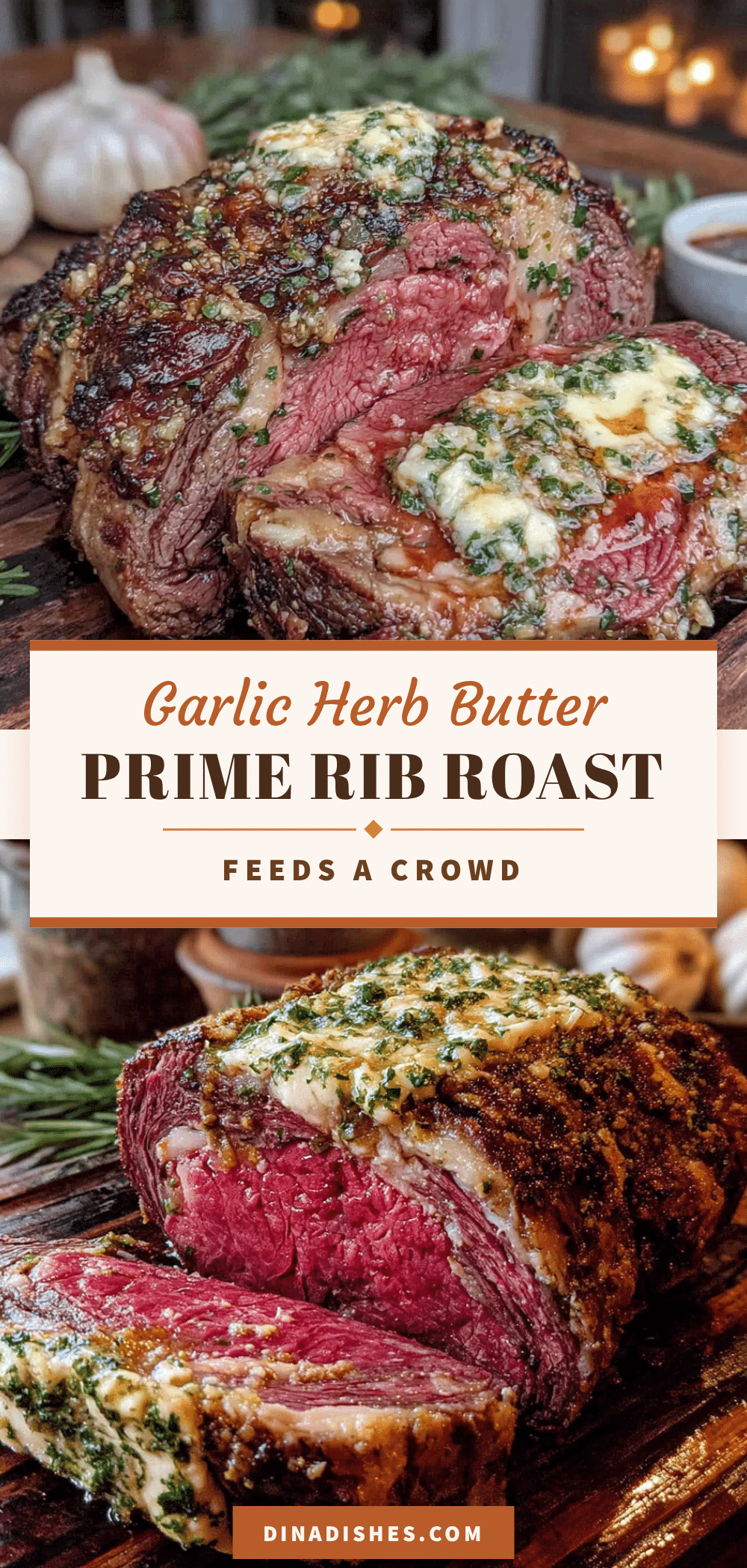
Best Garlic Herb Butter Prime Rib Roast for a Crowd
This garlic herb butter prime rib roast is the perfect centerpiece for feeding a crowd. With a flavorful herb butter crust and a perfectly pink, tender interior, it’s surprisingly simple to make and always impresses.
- Prep Time: 20 minutes
- Cook Time: 2 hours 30 minutes
- Total Time: 3 hours 20 minutes
- Yield: 8-10 servings 1x
- Category: Main Course
- Cuisine: American
Ingredients
- 1 cup unsalted butter, softened (2 sticks, 8 oz or 226g)
- 8 cloves garlic, minced (about 2 tablespoons or 30ml)
- 2 tablespoons fresh rosemary, finely chopped (about 6g)
- 2 tablespoons fresh thyme leaves (about 4g)
- 1 tablespoon fresh parsley, finely chopped (about 3g)
- 2 teaspoons kosher salt (10g)
- 1 teaspoon black pepper, freshly ground (2g)
- 1 teaspoon onion powder (2g)
- 1 bone-in prime rib roast, 7-8 pounds (3.2–3.6 kg)
- Additional kosher salt for seasoning (about 1 tablespoon or 15g)
- Fresh cracked black pepper (about 1 teaspoon or 2g)
- 2 cups beef broth (480ml)
- 1/4 cup dry red wine (60ml)
- 2 tablespoons pan drippings (from the roast)
- 1 teaspoon Worcestershire sauce (5ml)
- 1 tablespoon cornstarch mixed with 2 tablespoons cold water (optional, for thickening)
Instructions
- Make the garlic herb butter: In a medium mixing bowl, combine softened butter, minced garlic, rosemary, thyme, parsley, kosher salt, black pepper, and onion powder. Mix until well combined.
- Prepare the roast: Take the prime rib roast out of the refrigerator 2-3 hours before cooking. Pat dry with paper towels. Rub the garlic herb butter all over the roast, then sprinkle with additional kosher salt and fresh cracked black pepper.
- Sear the roast: Preheat oven to 450°F (232°C). Place the roast on a rack in a roasting pan, bone side down. Roast at 450°F for 20 minutes.
- Roast to doneness: Reduce oven temperature to 325°F (163°C) without opening the door. Continue roasting until internal temperature reaches 125°F (52°C) for medium-rare (about 2 to 2 1/2 hours total). Use an instant-read thermometer to check.
- Rest the roast: Remove from oven and transfer to a cutting board. Tent loosely with aluminum foil and let rest for 20-30 minutes.
- Make the au jus (optional): Pour pan drippings through a fine-mesh strainer into a small saucepan. Add beef broth, red wine, and Worcestershire sauce. Bring to a simmer over medium heat, scraping up browned bits. Simmer for 5-7 minutes. For thicker gravy, whisk in cornstarch slurry and simmer 1 minute more. Strain again before serving.
- Carve and serve: Remove kitchen twine. Slice between bones to separate them, then slice meat against the grain into 1/2-inch to 3/4-inch thick slices. Arrange on a warm platter and spoon some au jus over the top. Serve remaining au jus on the side.
Notes
Let the roast come to room temperature before cooking for even doneness. Use a probe thermometer to monitor temperature without opening the oven. Don’t skip the resting period. For extra flavor, salt the roast the night before and dry brine in the refrigerator.
Nutrition
- Serving Size: 6 oz (170g) without
- Calories: 475
- Sodium: 450
- Fat: 37
- Saturated Fat: 16
- Carbohydrates: 1
- Protein: 37
Keywords: prime rib, garlic herb butter, roast beef, holiday dinner, Christmas dinner, special occasion, beef roast